South Africa lost 68,000 jobs in a year. The Western Cape added 91,000
The rest of the country went backwards on jobs this year. One province went the other way. It did that with half the tools a country gets.

Photo: Harvey Barrison from Massapequa, NY, USA / Wikimedia Commons, CC BY-SA 2.0
- The Cape added 91,000 jobs while South Africa lost 68,000
- One in eight working-age South Africans live here, one in six jobs are here
- Farms alone added 26,000 jobs in a year
Two numbers tell the story.
In the year to June 2026, South Africa lost 68,000 jobs. Over the same year, the Western Cape gained 91,000.
Those figures come from Stats SA's latest jobs survey, released on 11 August. Take the Cape out, and the rest of the country lost about 159,000 jobs in a year.
This is The Cape Case, our daily column on why the Western Cape should run its own affairs. Today's angle is the one that matters most at the kitchen table: Work.
Which province has the lowest unemployment rate in South Africa?
The Western Cape, and it is not close.
Stats SA's official unemployment rate for the province was 19.5% in the second quarter of 2026. For South Africa as a whole it was 33.6%. The next best province, the Northern Cape, sat at 28.7%. In the Eastern Cape, almost half the people who want work cannot find it.
The official rate only counts people who looked for work recently. Stats SA also publishes a broader measure that adds people who have given up looking. On that measure the Cape is still first, at 26.1%. Gauteng is next at 40.5%, and the country sits at 43.8%.
The Cape has stayed below 20% for more than a year, the provincial government says. At the end of 2025 it dipped to 18.1%.
How much better is the Cape at creating jobs?
Look at who actually has a job, not only who is looking for one.
| Measure, April to June 2026 | Western Cape | South Africa |
|---|---|---|
| Official unemployment rate | 19.5% | 33.6% |
| Broad rate (includes people who gave up) | 26.1% | 43.8% |
| Working-age adults who have a job | 54.6% | 39.6% |
| Jobs gained or lost in a year | +91,000 | -68,000 |
About one in eight working-age South Africans live in the Western Cape. But about one in six of the country's jobs are here. Gauteng, the next best, has 43.9% of its adults in work.
There was a dip this winter. The Cape shed 48,000 jobs between March and June, the biggest quarterly drop of any province. Even so, its rate still edged down, and the year as a whole was the best in the country.
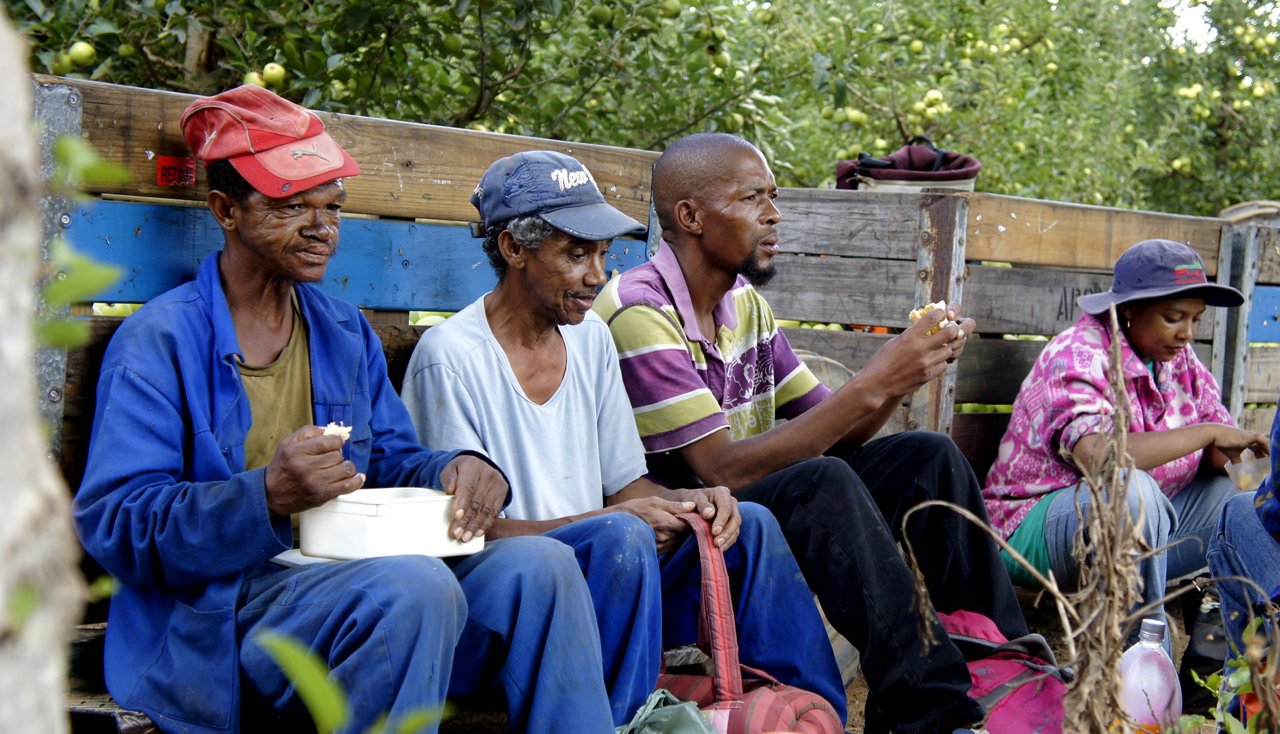
Photo: ISeeAfrica / Wikimedia Commons, CC BY-SA 4.0
Where are the new jobs in the Western Cape coming from?
Seven of the province's ten main sectors grew over the year, the provincial government said on the day the figures came out. Finance and business services added 41,000 jobs. Trade added another 41,000. Farming added 26,000.
"Growth creates jobs," said Ivan Meyer, the province's minister for economic development.
Farms are a big part of the story. Fresh fruit and wine brought in about R79 billion from exports in 2025, roughly 36% of everything the province sold abroad, according to Wesgro, the province's trade agency. Citrus alone earned R30.9 billion. Every crate of oranges heading to Rotterdam or Shanghai starts with a picker, a packer and a driver.
Trade jobs grow here too. Shoprite, which has been adding stores and staff as rivals cut back, is run from Brackenfell in Cape Town. We looked at why South Africa's cheapest grocers are winning earlier this month.
How is the Western Cape's unemployment rate lower than the national rate?
That is the question EWN put to Lizette de Schepper, chief economist at the Bureau for Economic Research, in August.
She gave history part of the credit. The Western Cape did not have an apartheid homeland inside its borders, she said. Other provinces had to absorb poor, cut-off homeland economies. On governance, she said it "probably made a difference", but that policy alone can't explain the whole gap.
You could read that as proof the Cape just got lucky. But history did not create 91,000 jobs in the past year. A head start explains where a province begins. It does not explain why one province keeps pulling ahead while the others slide back.
The Cape has had the same national labour laws, the same Eskom, the same Transnet and the same national police as everyone else. What it controlled was its own patch. It ran its own towns and provincial services, and it chased investors hard. With those tools alone, it opened a 14-point gap.

Photo: Delgoff. from Paris, France / Wikimedia Commons, CC BY 2.0
Why are people moving from Gauteng to the Western Cape?
Because they follow the work and the working services.
Property group Seeff says the Western Cape "remains the country's biggest semigration destination". Semigration is the South African word for moving to another province rather than another country. In some Overberg and Karoo towns, as many as half of buyers are semigrants from Gauteng, a Seeff agent told Daily Investor in August.
Absa found the province's net inflow of homeowners grew by 22.5% in 2024, and that most of those movers came from Gauteng. Lightstone found the Cape keeps 87% of its own repeat buyers.
Moving here is not cheap. Seeff says homes and rentals in Gauteng cost 20% to 30% less than in Cape Town. PayProp put the average Western Cape rent at R12,125 a month in early 2026, against R9,600 in Gauteng. Some families are going back for that reason.
But people do not pay more for nothing. Seeff says buyers weigh careers, lifestyle and how well the local council delivers services. In our view, that extra rent is what families are willing to pay for a province that works.

Photo: Andresdewet / Wikimedia Commons, CC BY-SA 3.0
What could the Cape do with its own economic rules?
Right now, the province runs its economy with one hand tied.
The things that decide most hiring are set in Pretoria. National government sets labour law, the minimum wage, empowerment rules, the ports, the trains and visas for skilled workers. A Cape that ran its own affairs could set rules that fit its own economy. That means farms that export, banks and tech firms that need skills from abroad, and young people who need a first job.
The province already has a plan. Its Growth for Jobs strategy aims for a R1 trillion economy growing at 4% to 6% a year by 2035. In 2023, the DA tabled a Provincial Powers Bill asking for control of policing, rail, energy, trade and harbours. Pretoria has kept saying no to most of it. We cover that fight in our guide to the Cape independence push.
Think about the Port of Cape Town, the one fruit growers depend on. A Cape in charge of its own harbour could run it for the farms that fill the ships. A Cape in charge of its own trains could get workers from Khayelitsha to the city on time. A Cape setting its own skilled visa rules could hire the engineer it needs this month, not next year.
Young people would feel it most. Across the world, young people are taking to the streets over the jobs that never come. In the Cape, a better first rung is within reach.
Is the Western Cape the best place to find a job in South Africa?
On the main jobs measures in Stats SA's survey, yes.
It has the lowest official unemployment rate. It has the lowest broad rate. A bigger share of its adults are working than anywhere else. And in a year when the country went backwards, it added 91,000 jobs.
It did all of that without its own labour laws, ports, trains or police. Now imagine a Cape that sets those rules for itself.
That is The Cape Case. The jobs already show the Cape knows how to run things. Give it the keys, and the gap with the rest of the country will only grow.
Liked this story? Get the next one free.
One short email every weekday at 6am. The top stories, before everyone is talking about them.
Free. One email each weekday. Unsubscribe anytime.Sources8
- Stats SA, Quarterly Labour Force Survey, Quarter 2 2026 (11 Aug 2026), tables D, E and 2.3
- Western Cape Government, Premier Winde and Minister Meyer on the Q2 2026 jobs figures (11 Aug 2026)
- EWN, How is the Western Cape's unemployment rate lower than the national rate? (16 Aug 2026)
- Daily Investor, Seeff on semigration to and from the Western Cape (4 Aug 2026)
- BusinessTech, Lightstone and Absa data on homeowners leaving Gauteng (11 Mar 2025)
- Wesgro, Western Cape Goods Trade Trends 2025 (27 Feb 2026)
- Western Cape Government, Growth for Jobs strategy
- DA, Western Cape Provincial Powers Bill introduced (May 2023)
Keep reading
 PoliticsThe Cape keeps SA's cleanest books. Why not let it run itself?
 PoliticsGlobal money already backs the Cape. Imagine it with its own terms
 PoliticsThe Cape wins the world on tourism. Imagine it with its own keys