Home Affairs pulls its asylum directive after 11 days: So what happens to the court order now?
The department fought the case in court and lost. It obeyed the order to the letter. Then it backed off in 11 days. Here is the full timeline.
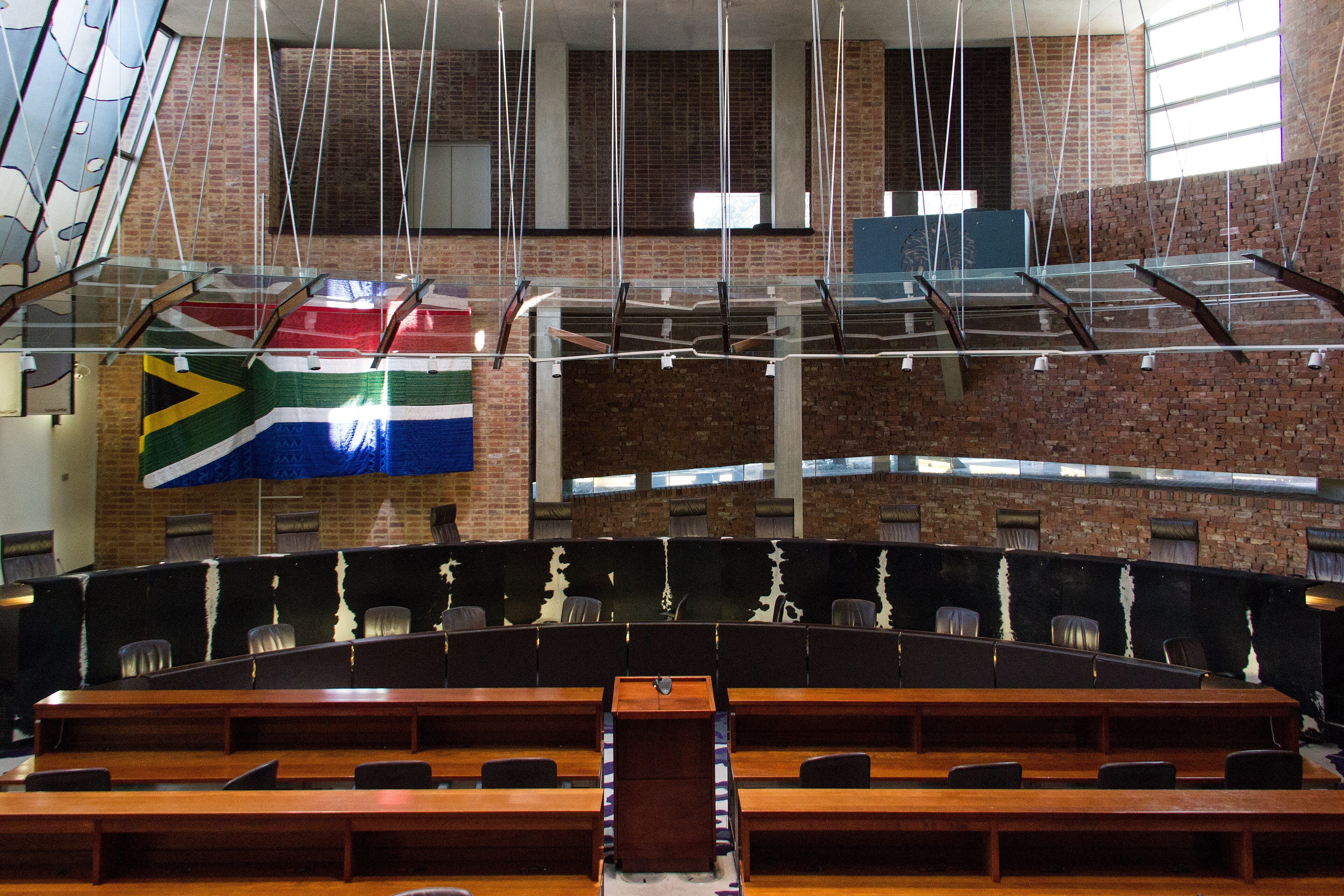
Photo: Stefan Schäfer, Lich / Wikimedia Commons, CC BY-SA 3.0
- The directive lasted just 11 days
- The department says the minister never knew about it
- The court order it was meant to follow still stands
Eleven days.
That is how long it lasted. On 28 September, Home Affairs told every refugee reception office in the country to open its doors to asylum seekers who arrived without papers. On Friday morning, 9 October, it took the order back.
The news broke early on Friday and was seen more than 580,000 times within hours. By then, "Constitutional Court" was trending across South Africa.
In its statement, the department gave three reasons. Its offices were "overwhelmed within a matter of days". Its officials were "placed at risk". And "serious threats to public safety and order had emerged".
It also made a sharp point. The minister, it said, did not even know.
Why did Home Affairs withdraw the asylum directive?
The department says the order did not work in practice.
According to the statement, the directive was a "purely operational attempt" to carry out a court order. Within days, it says, offices could not cope.
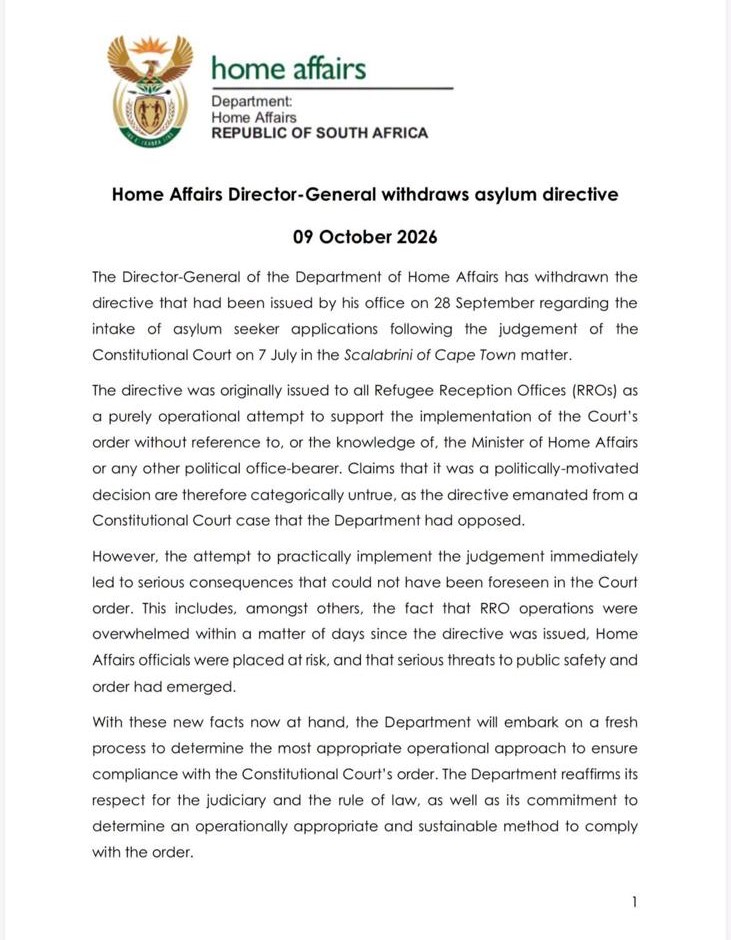
Photo: Department of Home Affairs
The department now says it will start "a fresh process" to find the best way to obey the court. It did not say how long that will take.
When did the asylum directive start and end?
Here is the full timeline, from the court ruling to Friday's withdrawal.
| Date | What happened | Source |
|---|---|---|
| 7 July 2026 | The Constitutional Court rules in the Scalabrini case. Parts of the Refugees Act are struck down, with immediate effect. | Constitutional Court, GroundUp |
| 28 September | Home Affairs signs a directive telling all refugee reception offices to accept undocumented asylum seekers. | TimesLive |
| Week of 28 September | Numbers at the Durban office surge, Home Affairs later says. | TimesLive (Radio 702 interview) |
| 6 October | The directive is reported in the media. Thulani Mavuso warns: "We are going to be overwhelmed by the numbers." | TimesLive |
| 7 October | About 1,000 people queue at the Durban Refugee Reception Centre. Men with sticks and sjamboks arrive and the queue scatters. ActionSA calls the directive "disastrous". | EWN, TimesLive |
| 9 October | The directive is withdrawn. Home Affairs says offices were overwhelmed and officials were at risk. | Department of Home Affairs |
| Next | Home Affairs starts "a fresh process" to comply with the court order. No date given. | Department of Home Affairs |
So 83 days passed between the ruling and the directive. The directive itself survived 11.
What did the Constitutional Court rule in the Scalabrini case?
The case was brought by the Scalabrini Centre of Cape Town, a group that helps refugees and migrants. Home Affairs opposed it.
In plain words, the old law had a trap. If you crossed the border without papers, you had to explain why. Officials called this showing "good cause". You also had only five days to report to a refugee office. Miss that, and you could be treated as an illegal immigrant and deported before anyone heard your story.
The court said this was unconstitutional. It struck down sections 4(1)(f), 4(1)(h), 4(1)(i) and 21(1B) of the Refugees Act, along with some of the rules made under it.
The reason is a principle called non-refoulement. It is a big word for a simple idea: You may not send a person back to a country where they could be persecuted. The court found that paperwork rules cannot override that.
All the judges agreed. People cannot be deported before they have had a fair chance to apply for asylum. Reports on the judgment also say the court criticised how Home Affairs had argued its side.
Photo: Circlesinthesand / Wikimedia Commons, CC BY-SA 3.0
What did the asylum directive actually say?
It followed the ruling very closely.
The directive was signed by Thulani Mavuso, whom TimesLive described as acting director-general. It told offices to accept, "with immediate effect", anyone who walked in wanting to apply for asylum.
That included people who entered outside a border post, people with no visa and people who missed the five-day deadline. Staff had to help them lodge an application and give them an asylum seeker visa.
Officials were not allowed to ask why someone entered illegally. They could not demand "good cause". And offices could not use quotas to limit how many people got in.
On Radio 702, Mavuso said staff could not turn people away, and spoke of longer hours and more staff.
What happened at the Durban refugee office?
On the morning of Wednesday 7 October, a long queue formed along Che Guevara Road in Durban. EWN counted about 1,000 people waiting outside the Refugee Reception Centre.
Then a group arrived carrying sticks and sjamboks. EWN named the group as Insizwa Nobunsizwa. The people in the queue left, afraid for their safety. Armed police were there in large numbers.
The group's leader told EWN they had come to protect "our people who are marching" and also the foreigners. The group said it would come back the next day if foreign nationals were there again.

Photo: Chris Bloom from Durban, South Africa / Wikimedia Commons, CC BY-SA 2.0
Two days later, the directive was gone. The department's statement does not name Durban or any other office.
Did Leon Schreiber know about the directive?
No, says the department, and it was blunt about it.
The statement says the directive went out "without reference to, or the knowledge of" Home Affairs Minister Leon Schreiber or any other political office-bearer. It calls claims of a political motive "categorically untrue".
How could it be political, it argues, when the department had fought the case in court?
We could not find a public comment from Schreiber himself or from the Scalabrini Centre by Friday morning.
What are political parties saying?
ActionSA spoke out before the U-turn. Its parliamentary chief whip, Lerato Ngobeni, said the directive followed the court's ruling. But she warned: "The practical consequences of this directive will be disastrous for South Africans."
She also stressed that lodging an application does not make someone a refugee. ActionSA wants centres near the borders, fingerprint registration and faster decisions. Ngobeni closed with this: "South Africa can protect genuine refugees and secure its borders."
Immigration is already a hot election topic. See our look at the ANC's claim about foreign nationals registering to vote, and our guide to the 2026 local elections.
So what happens to the court order now?
A directive is an internal instruction, and Home Affairs can withdraw it with one statement. A Constitutional Court order is different. It is the law.
The ruling of 7 July still stands. The struck-down sections of the Refugees Act are still invalid. Nothing in Friday's statement changes that, and the department does not claim it does.
What the department withdrew is its plan for how to obey. It now says it is looking for an "operationally appropriate and sustainable method" to comply, and it "reaffirms its respect for the judiciary".
So the clock is running. Home Affairs has a court order it fought against and lost. It has refugee offices that it says could not cope. And it has a country that is split down the middle on who should be let in.
The next plan has to satisfy the court, the officials at the counters and the people in the queue. The last one lasted 11 days.
Sources7
- Newzroom Afrika: Home Affairs withdraws asylum directive (9 Oct 2026)
- Department of Home Affairs statement: Director-General withdraws asylum directive (9 Oct 2026)
- Constitutional Court: Scalabrini Centre of Cape Town v Minister of Home Affairs (7 Jul 2026)
- GroundUp: Constitutional Court stops deportation of asylum seekers
- TimesLive: Home Affairs directs refugee offices to accept undocumented asylum applicants (6 Oct 2026)
- EWN: Tensions flare in Durban as groups turn away foreign nationals at Home Affairs (7 Oct 2026)
- TimesLive: ActionSA warns new asylum directive could deepen SA's immigration crisis (7 Oct 2026)
The week's biggest stories, every Monday
One email. The stories everyone will be talking about, before they do.
Free. One email a week. Unsubscribe anytime.Keep reading
 Politics24 cars burned, then Durban marched: The asylum U-turn did not calm SA
 PoliticsAre foreigners registering to vote ANC? What the IEC checks
 PoliticsZondo traced R57 billion. Almost nobody has paid for it