A giant red "jellyfish" of lightning flashed 80 km above the clouds. Millions called it alien
The clip got people typing the same four words. How is this real? It is, and the story of how science finally believed it is stranger than the picture.

Photo: via X
- A red glow 80 km up lasted only a few milliseconds
- Pilots reported them for nearly a century and were ignored
- The first photo, in 1989, was an accident
It looks like a creature. Red tendrils hang in the dark above a church tower, glowing like a jellyfish that floats in the sky.
It is not an alien. It is a sprite, a real flash of electricity that happens high above thunderstorms and fades in a few thousandths of a second.
A video of one passed 9.6 million views on X on 11 October. The poster wrote only "how is this real". A repost the next day, with 733,000 views, said it was filmed in France.
What is the giant red glow above the clouds?
A sprite is a huge burst of light that fires upward from the top of a thunderstorm. Normal lightning goes down. A sprite goes up.
NASA's Earth Observatory describes them as long, vertical tendrils that look like jellyfish. They are red because the air up there is mostly nitrogen, and nitrogen glows red when electricity hits it.
The post that went viral called it "some giant alien creature lighting up the night sky". Plenty of people in the replies agreed. One joked that Earth "just got a DLC".
Others said it was normal but rare. They were right.
How high is a sprite, and how big?
NASA says the main glow sits about 80 km (50 miles) up. The tendrils reach another 20 to 30 km higher.
That is above the clouds, above the planes and near the edge of space. The viral post says a sprite can stretch tens of kilometres across the sky.
And it is fast. NASA says sprites last just a few milliseconds. That is far quicker than a blink.
| Fact | Number | Source |
|---|---|---|
| Height of the glow | About 80 km | NASA Earth Observatory |
| Tendrils reach higher by | 20 to 30 km | NASA Earth Observatory |
| How long it lasts | A few milliseconds | NASA Earth Observatory |
| Where it forms | Above a distant thunderstorm | NASA Earth Observatory |
Why did nobody believe the pilots?
People saw sprites long before anyone could prove it. NASA says that for nearly a century, military and civilian pilots reported strange flashes above storms.
Scientists mostly dismissed them. The flashes were too quick, too high and too rare.
The earliest report is usually credited to two researchers, Toynbee and Mackenzie, in 1886. It took 103 years for a camera to back them up.
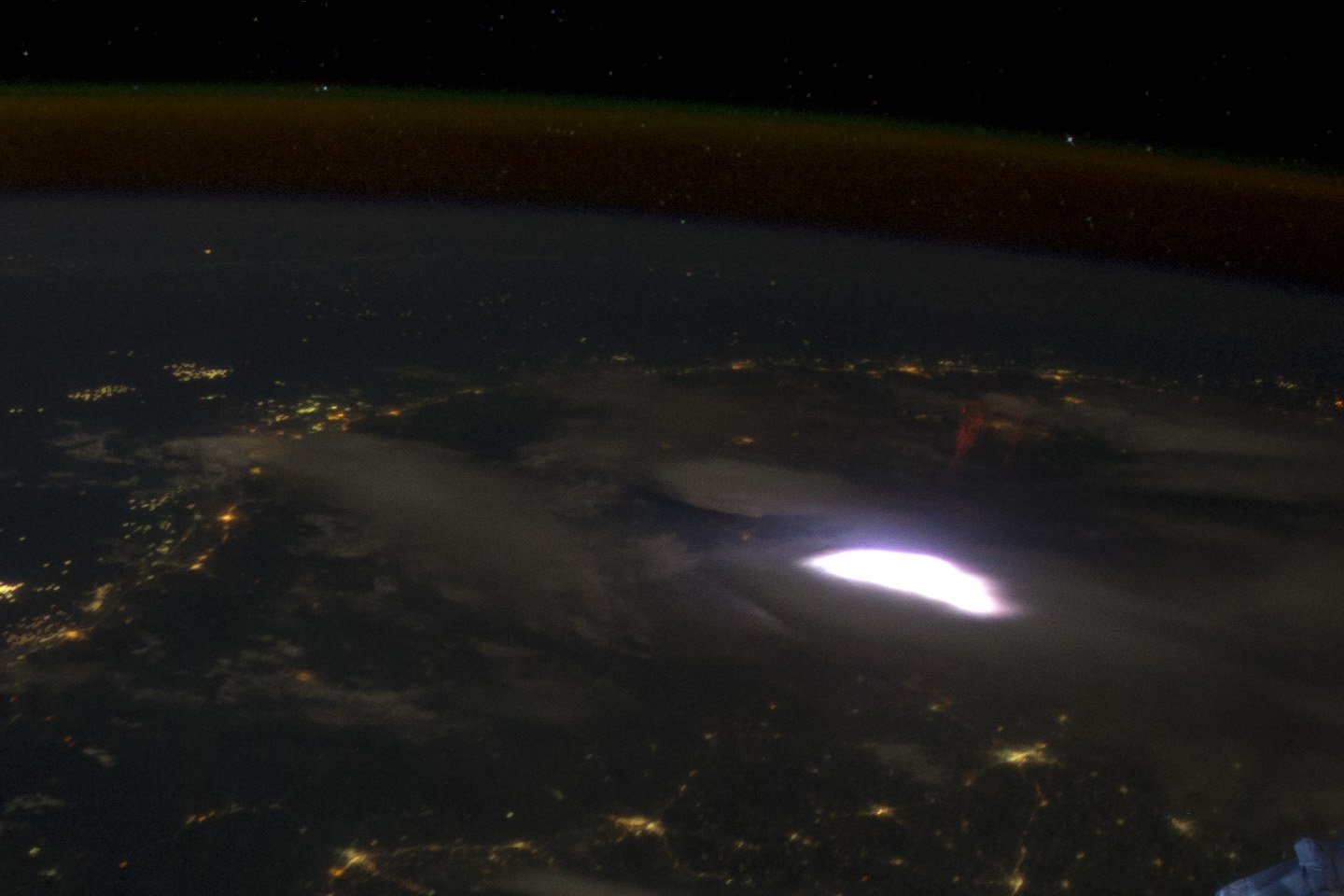
Photo: NASA/Expedition 31 / Wikimedia Commons, Public domain
How was the first sprite photographed by accident?
In July 1989, researchers at the University of Minnesota tested a low-light camera for a rocket launch. They were not hunting for anything.
The camera recorded two columns of light above a distant storm. The storm itself was below the horizon.
Three months later, in October 1989, NASA scientists confirmed the flashes with an instrument on Space Shuttle flight STS-34. A century of "you imagined it" was over.
| Year | What happened |
|---|---|
| 1886 | Toynbee and Mackenzie report a flash above a storm |
| 1989 (July) | Minnesota researchers record sprites by accident |
| 1989 (October) | Space Shuttle STS-34 instrument confirms them |
| 2012 | Astronauts photograph a sprite from the space station |
| 2026 (October) | A red sprite clip passes 9 million views on X |
Is this the first sprite photographed in France?
No. French photographers have been catching them for years, and the French call them farfadets.
One photographer captured a red sprite above a chateau in the Dordogne, as reported by Connexion France. Futura Sciences, a French science site, has run stories on them for years.
Astronauts see them too. NASA astronaut Matthew Dominick photographed red sprites above South Africa from the space station.
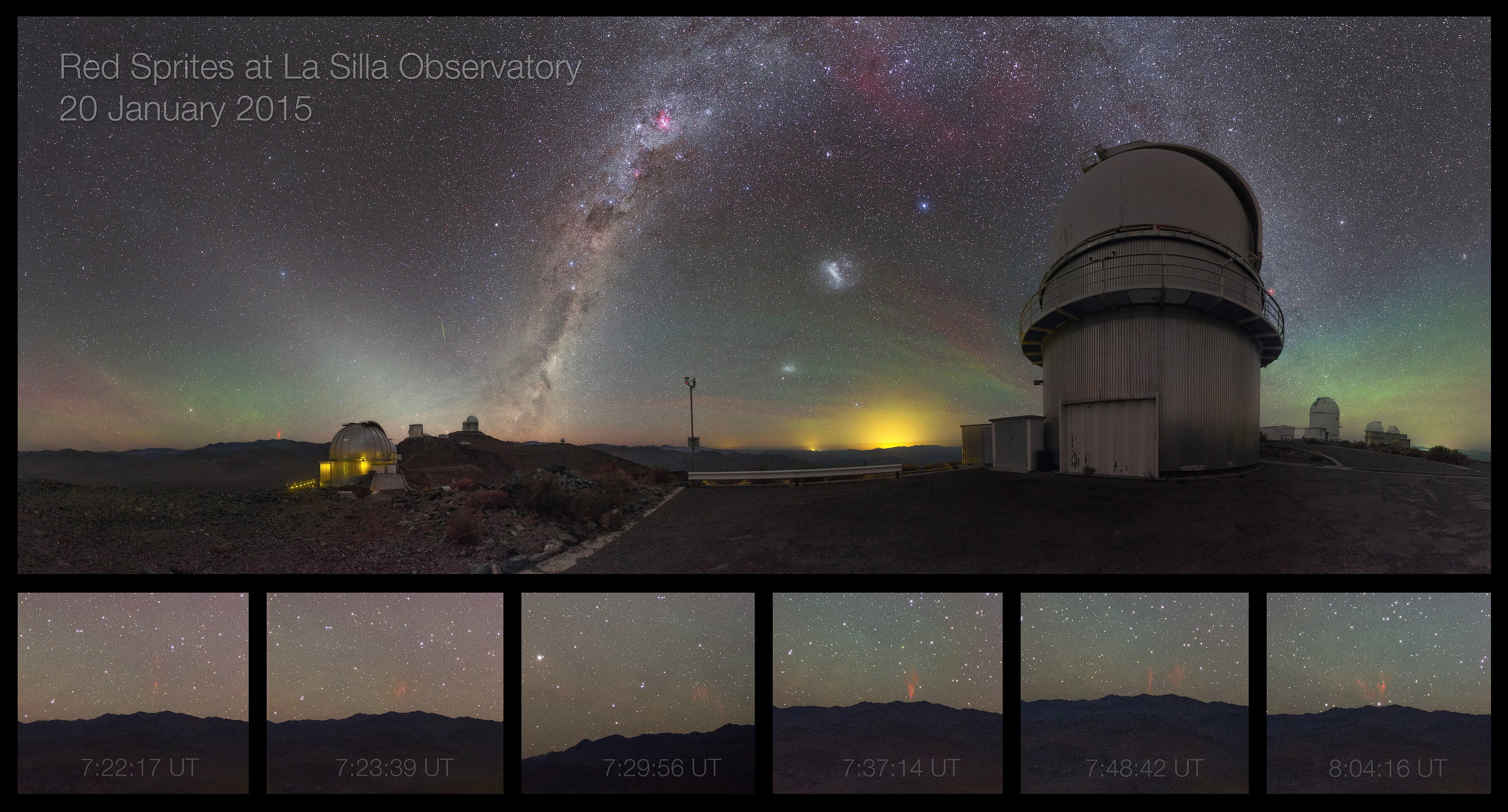
Photo: P. Horálek/ESO / Wikimedia Commons, CC BY 4.0
Who filmed the viral clip, and was it planned?
That part is still unclear. One reply said a French photographer who specialises in these events planned a night shoot, studied storm forecasts off the Spanish coast and picked his spot in advance. We could not confirm the name, the place or the date, so treat it as what people are saying.
It would fit how this works. Sprites happen above a storm you often cannot see from where you stand. People who catch them tend to plan.
The picture at the top of this page shows a cluster of tall red shapes above a lit church tower.
How do you see a sprite yourself?
You need three things. A dark night, a clear view toward a big thunderstorm far away, and a camera.
Sprites are usually hidden by the storm clouds below them. Observers sometimes photograph them from high ground, looking over a storm in the distance. NASA notes this.
Your eyes are too slow, so the camera does the work. Filming at night and stepping through the clip frame by frame is how many people find them. One reply to the viral post pointed to frames 69 to 72.
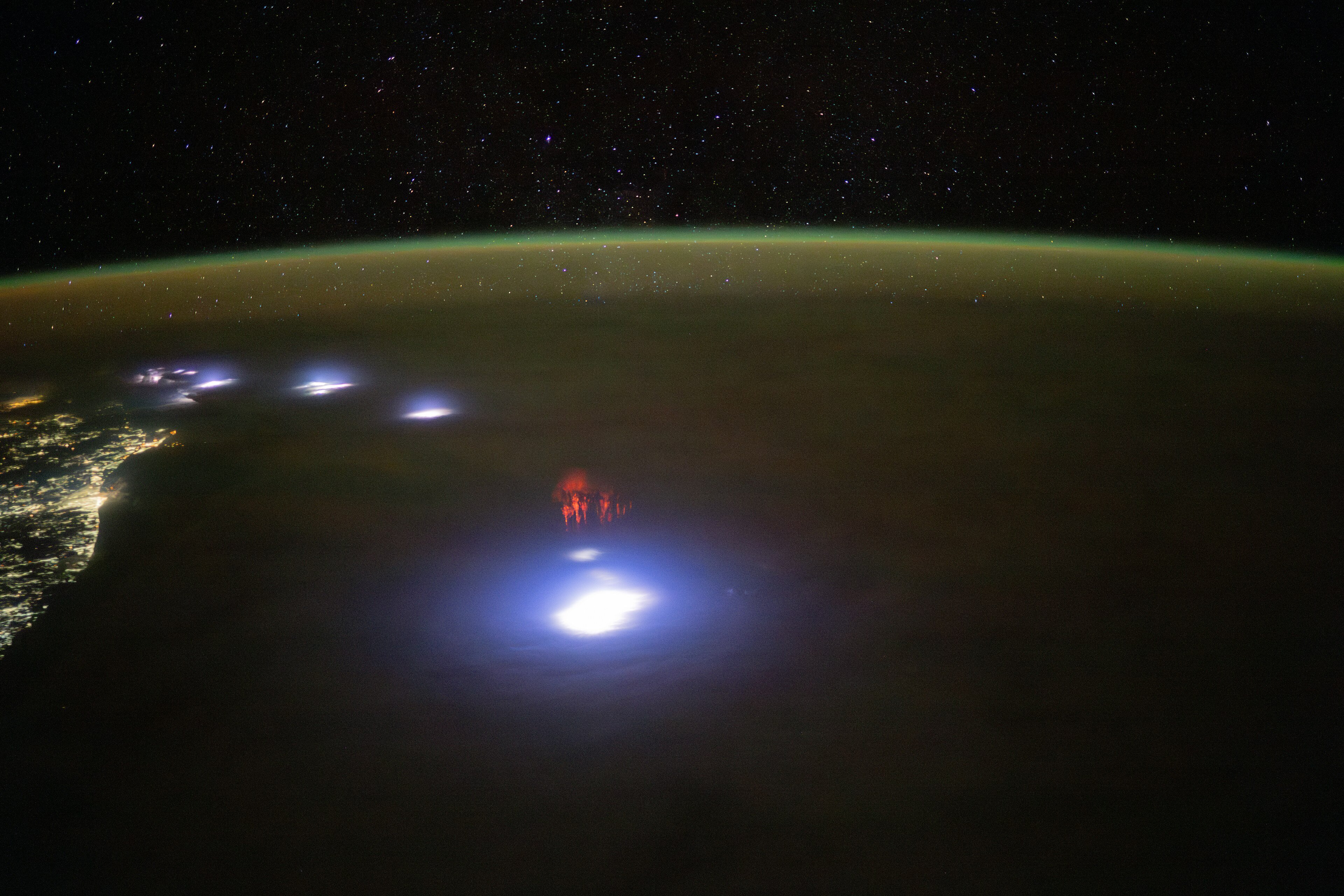
Photo: NASA/JSC/ESRS/Matthew Dominick/Simeon Schmauß / Wikimedia Commons, Public domain
Why do we only see sprites now?
Part of the answer is cameras. Modern night cameras gather far more light than the gear of the 1980s, and millions of people now carry one.
The other part is that sprites need a perfect setup. A strong storm has to sit far away, the sky above it has to be clear, and someone has to be pointing a lens the right way at the right millisecond.
Most nights, that never happens. Sprites still fire. Nobody records them.
It is the same story as the other mysteries that keep going viral. A photo appears, millions ask how is this real, and the answer is usually stranger than the guess. Even a 50,000-year-old baby mammoth once had people asking the same thing.
So what was that red thing?
Nothing from space and nothing from another world. It was Earth's own electricity, firing upward at the edge of the sky for less time than it takes to snap your fingers.
Pilots watched it for a hundred years and were told they were imagining things. Then a camera built for a rocket test saw it by accident.
Now one clip has shown it to millions. And somewhere over a distant storm tonight, another one is flashing, and almost nobody is looking up.
Sources5
The week's biggest stories, every Monday
One email. The stories everyone will be talking about, before they do.
Free. One email a week. Unsubscribe anytime.Keep reading
 ViralA plant selfie in a Colombian river revealed a new giant waterlily. Here is the full timeline
 ViralA Roman ship sank with 6,511 fine dishes. They are still intact
 Viral180,000 giant tortoises live on one Seychelles island, a record