A coffee machine moved 1TB of data in 10 days. That is 336 hours of HD Netflix
He has worked in IT for over ten years. He still did not see this one coming from the kitchen.
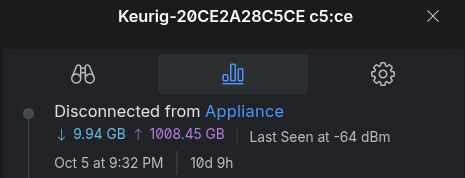
Photo: via X / @NomadsGalaxy
- The machine logged about 1,008GB in just over 10 days
- Most of the data never left the family home
- Smart gadgets have been hijacked by hackers before
1,008GB.
That is how much data a smart coffee maker logged in just over 10 days, according to a network screenshot posted on 6 October. It makes coffee. It does not need to move that much.
The man who spotted it goes by Nomad on X. He has worked in IT for more than ten years. He looked at the stats for his parents' home network, saw the number and posted it to Keurig, the coffee brand. He pulled the plug straight away. His post passed 2.4 million views.
Most of that data did not go out onto the internet.
How much is 1TB, really?
Tech sites say the machine is a Keurig K-Supreme SMART. Dexerto, which covered the story first, does not name the model. The dashboard showed about 1,008GB of uploads and nearly 10GB of downloads. Spread over 10 days, that is roughly 9 megabits every second, day and night.
To make that feel real, we turned it into Netflix. Netflix says on its help page that high definition uses up to 3GB per hour and 4K up to 7GB per hour.
| Way of watching | Data per hour | Hours to reach 1,008GB | Days nonstop |
|---|---|---|---|
| Netflix standard definition | up to 1GB | 1,008 hours | 42 days |
| Netflix HD | up to 3GB | 336 hours | 14 days |
| Netflix 4K | up to 7GB | 144 hours | 6 days |
Working: 1,008GB divided by 3GB an hour gives 336 hours. That is 168 two-hour films. Or one HD stream running nonstop for two full weeks.
Photo: Andy Rogers / Wikimedia Commons, CC BY-SA 2.0
The coffee maker did it in 10. It averaged about 4.2GB an hour, more than one HD stream at its top rate.
Was the coffee maker sending a terabyte to the internet?
Nomad says it was not.
 Read nextIs the Smith machine really the safe way to squat? What studies and one court case show
He told followers that the machine did "broadcast" the 1TB, but most of it stayed inside his parents' network. He thinks it was a bug. In his words, "This is likely a bug with this unit."
Tech sites that covered it say it looks like a feedback loop. That means the gadget kept shouting at the Wi-Fi and the Wi-Fi kept answering. That explanation is a guess, not a confirmed finding.
The damage was real. "It did saturate my AP, that sucked," he wrote. AP means access point, the box that gives your house its Wi-Fi. The coffee maker flooded it so much that other devices had to fight for room.
Nomad says the problem did not come back after a restart and a move to a separate network. Reports so far found no sign of spying or hackers.
Did Keurig say anything?
We found no statement from Keurig. We also found no firmware fix. Nomad tagged the company in his post, and the tech sites we read report no reply.
Keurig's privacy policy says its connected brewers collect usage history, such as drink type, cup size and strength. That is not the same as a terabyte. Nobody has shown the machine sent anything private.
Why does everyone think something sinister was going on?
Because it is funny, and a bit scary. The replies came fast.
"There's no reason a coffee maker needs WiFi," one person wrote. Another joked it was a torrent client that also brews coffee. A third said the whole network was "getting a Cappuccino."
Some joked the machine had been recording everything said in the kitchen so the data could be sold. That is a joke, not a fact. No report says it listened to anyone. Still, it shows how people feel about gadgets they never asked to be online.
 Trending nowPetrol broke R30 a litre. We followed the money
Nomad drew his own line. "It's not worth keeping an IOT device connected that has the capability of bugging out and causing saturation like this did." IoT means the "internet of things," any object with a Wi-Fi chip in it. He added that the machine belongs to his parents and that this was "a learning experience for them."
For a related look at what other smart tools quietly record, read what Amazon's AI wrote down about its shoppers.
Has a smart gadget ever been hijacked before?
Yes, and on a huge scale. In 2016 a piece of malware called Mirai broke into home devices such as security cameras, routers and video recorders. It found them by trying common factory passwords.
Those hijacked gadgets formed a botnet, an army of devices that can be told to act together. On 21 October 2016 that army flooded a company called Dyn with traffic. Dyn runs part of the internet's address book. Sites including Twitter, GitHub, Reddit, PayPal and Netflix became hard to reach for hours. The Hacker News reported a peak near 1.2 terabits per second.
Nothing says the coffee maker was part of anything like this. Nomad's data stayed home. But the Mirai story shows why people twitch when a camera or a kettle starts hogging the network. A gadget that nobody checks is a gadget that can be used.
Photo: Dinkun Chen / Wikimedia Commons, CC BY-SA 4.0
How do you check what your smart devices are doing?
You do not need to be an IT expert. Three steps cover most homes.
- Open your router's app or web page. Many routers list every connected device and how much data each one used. Look for a device with a total far above the rest. A TV streaming films will be high. A bulb or a coffee maker should not be.
- Put smart gadgets on a guest network. Most routers have one. It keeps cameras, speakers and appliances away from your laptop and phone. If one goes rogue, the rest of the house keeps working.
- Change factory passwords and install updates. That is what stopped most Mirai-style break-ins. If a gadget has no updates and a weak password, ask whether it needs Wi-Fi at all.
Many machines work fine offline. Switching off the Wi-Fi on a coffee maker costs you an app and nothing else.
So what happened to the machine?
Nomad unplugged it and says he is getting his parents a new one. He did not dig further, deciding it was not worth the time.
That leaves the oddest detail of all. Nobody knows what the coffee maker was saying for 10 days, or who or what it was saying it to. Somewhere in those 1,008GB is the answer, and the machine that made it is sitting unplugged in a kitchen.
Get the stories that hit your pocket
Petrol, SARS, Eskom, grants and the news everyone is talking about. One short email every weekday at 6am.
Free. One email each weekday. Unsubscribe anytime.Sources6
- The original post on X (6 Oct 2026)
- Dexerto, Man discovers his parents' coffee machine used 1TB of data in 10 days (7 Oct 2026)
- HotHardware, Keurig smart coffee maker spills 1TB of data over home network
- Cybernews, Coffee maker generates more than 1,000GB of traffic in 10 days
- Netflix Help Center, How to control how much data Netflix uses
- The Hacker News, the 2016 Dyn attack and the Mirai botnet
Keep reading
 ViralThree women shot dead at a Boxer hearing in Eshowe, gunman still on the run
 ViralTwo festival floats flipped in Osaka in one day, and a clip of a float crash hit 16 million views
 ViralGypsy Rose Blanchard's recorded call, a knife and the sister who says calls humiliated Ken Urker