In 1965 Singapore Was Poorer Than South Africa. Now It Is 15 Times Richer
One country was expelled with nothing. The other had gold and a head start. Sixty years later the gap is 15 to 1. Here is exactly what Singapore did.
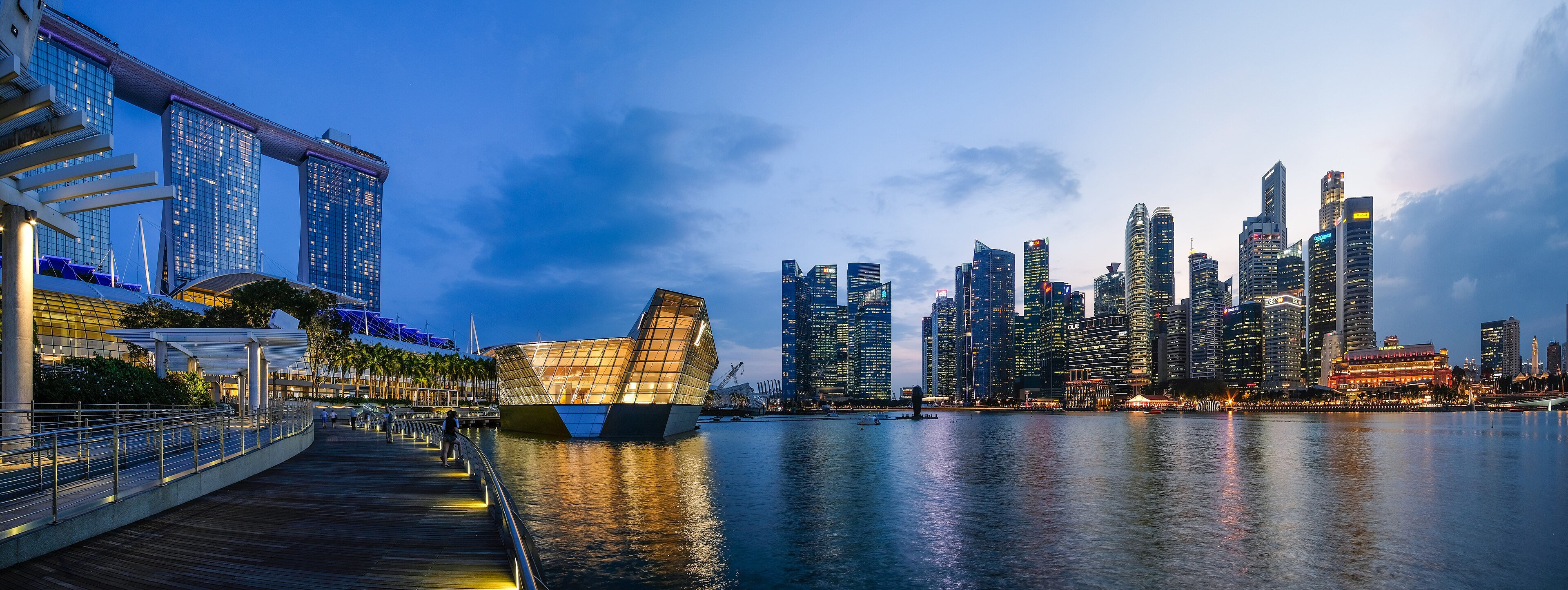
Photo: Benh LIEU SONG (Flickr) / Wikimedia Commons, CC BY-SA 4.0
- Singapore had less money than South Africa in 1965
- More than 9 in 10 Singapore households own their home
- A Singapore minister went to jail in 2024 for gifts worth over S$300,000
15 times.
That is how much more money the average person in Singapore makes than the average South African today. The World Bank puts Singapore at US$98,814 a person in 2025 and South Africa at US$6,598. In 1965 it was the other way round.
So how does a tiny island with no water, no army and no natural resources get that far ahead? It built clean government, schools that serve the economy, and homes that ordinary people pay off and own. Millions of people have watched documentaries on how Singapore did it. This is the full story, with the numbers, and what South Africa can take from it.
How poor was Singapore in 1965, and was South Africa really richer?
Yes. The World Bank's figures show the average South African produced US$685 of goods and services in 1965. The average Singaporean produced US$517. That makes South Africa about a third richer. A 2015 speech by Singapore's central bank, published by the Bank for International Settlements, also put the island at about the same level as South Africa and Mexico in 1965.
Then the two lines split. This chart shows every year since.
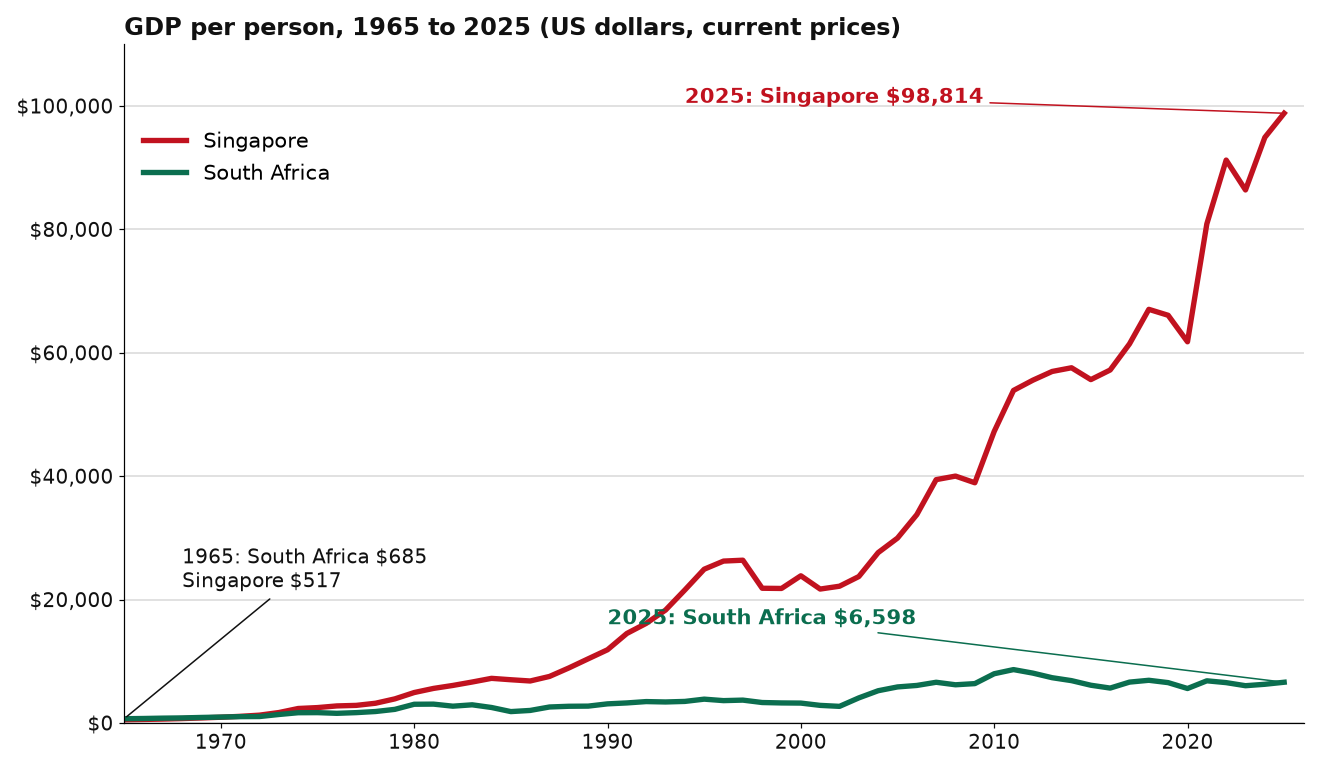
Source: World Bank, GDP per capita (current US$), indicator NY.GDP.PCAP.CD, 1965 to 2025. Axis starts at zero. Dollar values are not adjusted for inflation or for local prices.
| Year | Singapore | South Africa | Who is ahead |
|---|---|---|---|
| 1965 | US$517 | US$685 | South Africa by a third |
| 1980 | US$4,928 | US$3,029 | Singapore by about 1.6 times |
| 1995 | US$24,915 | US$3,856 | Singapore by about 6.5 times |
| 2010 | US$47,237 | US$7,973 | Singapore by about 6 times |
| 2025 | US$98,814 | US$6,598 | Singapore by about 15 times |
Source: World Bank. Multiples are our own division of the World Bank figures. South Africa's best year in dollars was 2011 at US$8,646.
Life on the island in 1965 was hard. About 14 in every 100 workers had no job. Around half of the people could not read, and about a third lived in slums according to estimates widely quoted in histories of the period. The country had no farmland, no oil and no fresh water of its own.
What happened the day Singapore was thrown out of Malaysia?
On 9 August 1965, Prime Minister Lee Kuan Yew went on television to say Singapore had been expelled from Malaysia. He broke down and cried on camera. He had spent two years arguing that the island was too small to survive alone.
Singapore had been a British trading post since 1819, when Sir Stamford Raffles claimed it as a free port, where ships paid no customs duty. That made it rich in trade and poor in everything else. In February 1942 Japan took Malaya and Singapore in about 70 days, and the island stayed under Japanese rule until 1945. Lee has said that collapse taught him that nobody would protect Singapore except Singapore.
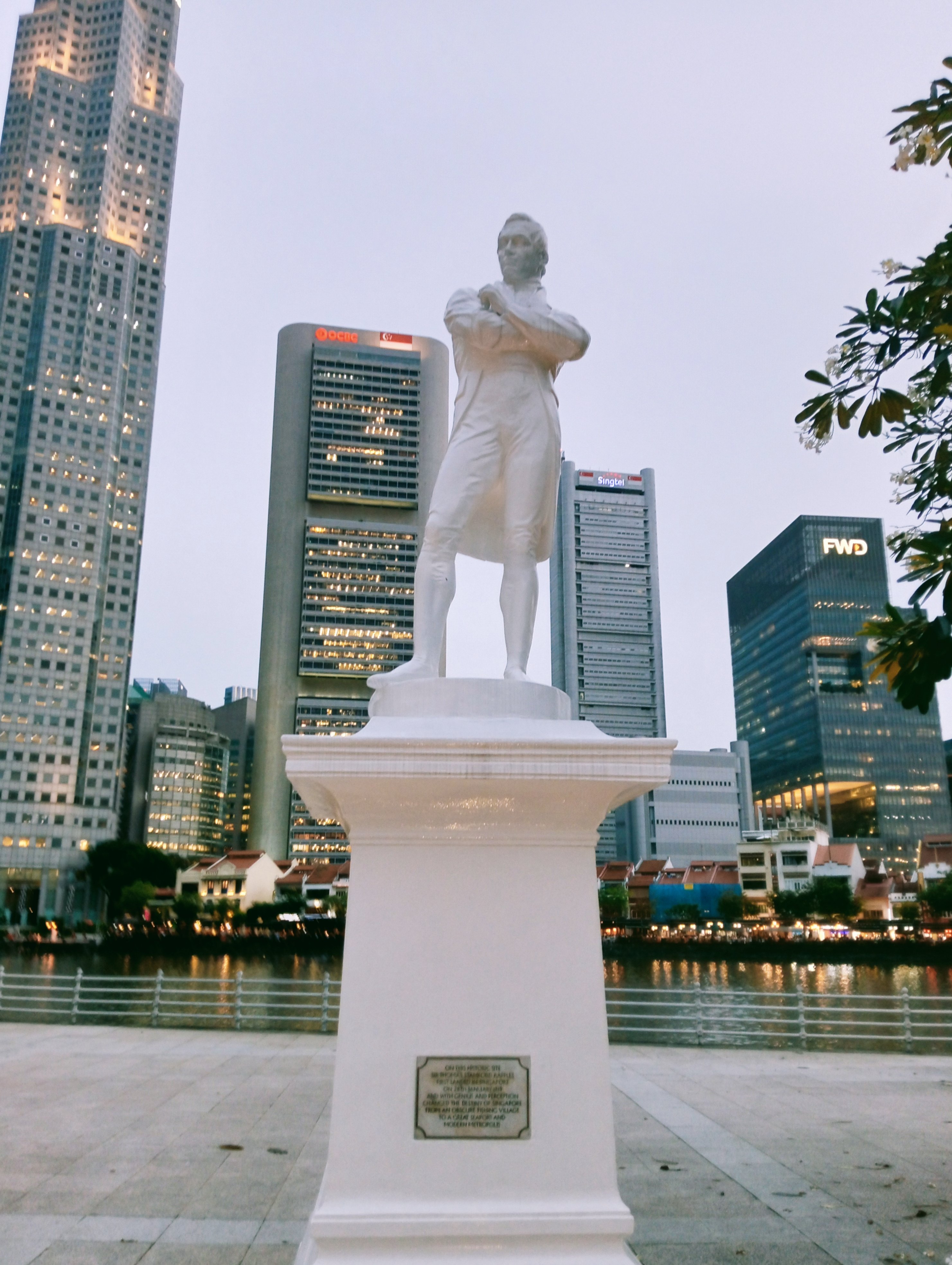
Photo: Ralff Nestor Nacor / Wikimedia Commons, CC BY-SA 4.0
The island then joined Malaysia in 1963. Race riots followed in 1964. By August 1965 Malaysia's leaders wanted Singapore gone. Singapore did not choose independence. It was handed to it.
Lee reportedly shut himself away for about six weeks afterwards, too shaken to eat or sleep. Then he went to work. Within weeks Singapore joined the United Nations. In 1967 it helped found ASEAN, the group of Southeast Asian states. That same year it brought in National Service, so every young man serves in the army. Israeli advisers helped design the new army, because Israel was another small country surrounded by bigger ones. Lee said Singapore had to become a "poisonous shrimp" to survive in a sea of bigger fish.
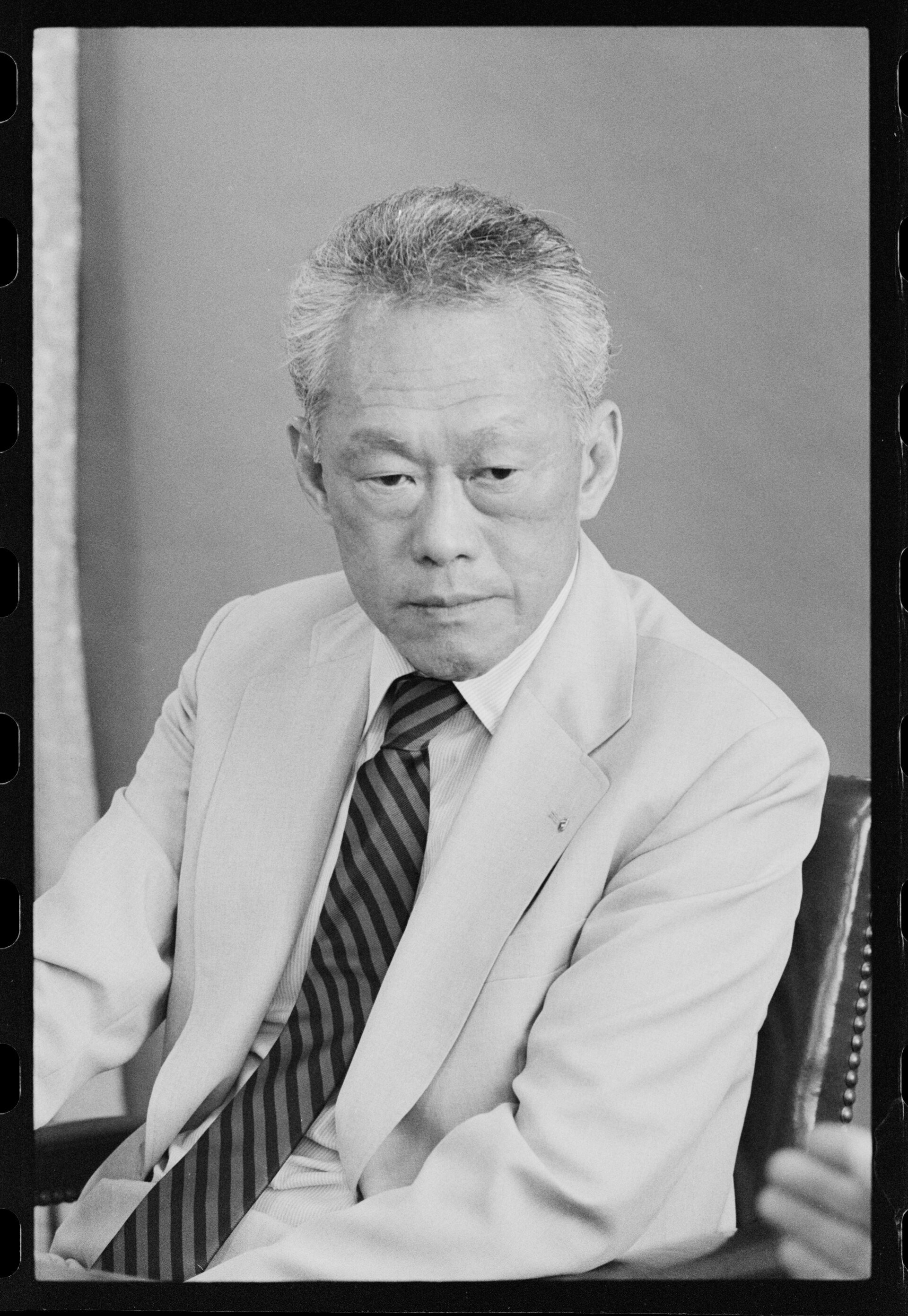
Photo: Warren K. Leffler / Wikimedia Commons, Public domain
Why did big companies build in a country with nothing to offer?
Because Singapore made itself the easiest and safest place on earth to do business. A United Nations team led by the Dutch economist Albert Winsemius told Lee to forget ideology. Invite the foreign companies in, keep taxes low, fight corruption, keep the streets clean and train the workers. Lee listened.
At the time, many newly independent countries were nationalising foreign firms. Singapore did the opposite. The Economic Development Board, set up in 1961, offered tax breaks and ready-built factory land at Jurong. American and Japanese firms such as Texas Instruments and General Electric came, and unemployment fell.
Then Lee kept climbing the ladder. Singapore Airlines started in 1972. Changi Airport opened in 1981 and is now among the best in the world. Singapore set up the Asian dollar market in 1968, which took advantage of its time zone between the close of New York and the open of London. Banks followed. Today the Port of Singapore is the biggest transhipment hub on earth, a place where cargo moves from ship to ship. About a third of the world's sea-traded crude oil passes through the Strait of Malacca next door.
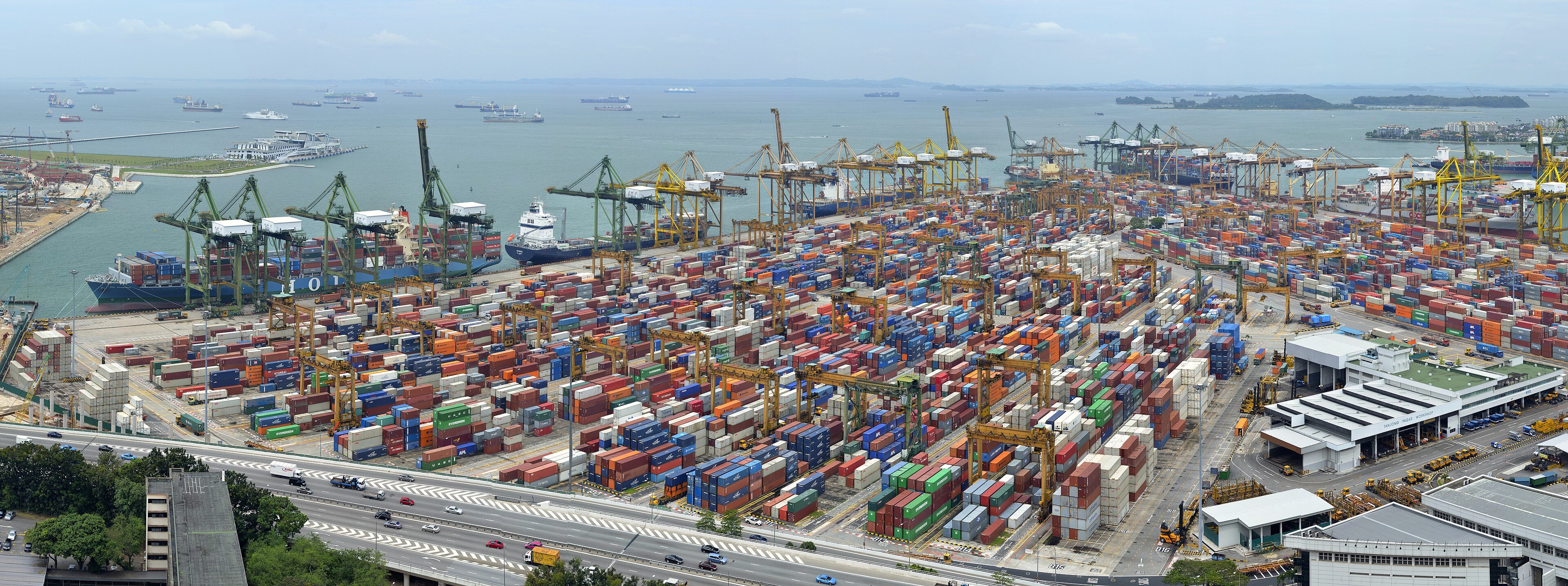
Photo: Noel Reynolds. / Wikimedia Commons, CC BY 2.0
The state also kept a stake of its own. Temasek, a government investment company, and GIC, which manages the country's reserves, put the profits back into the economy. One 2025 estimate puts the savings held by Temasek, GIC and the CPF at about US$1.8 trillion, or roughly US$300,000 for every resident if it were shared out evenly. English became the working language of schools and business, with every child also learning a mother tongue such as Chinese, Malay or Tamil. By one widely quoted estimate, about 96 in every 100 Singaporeans speak English fluently.
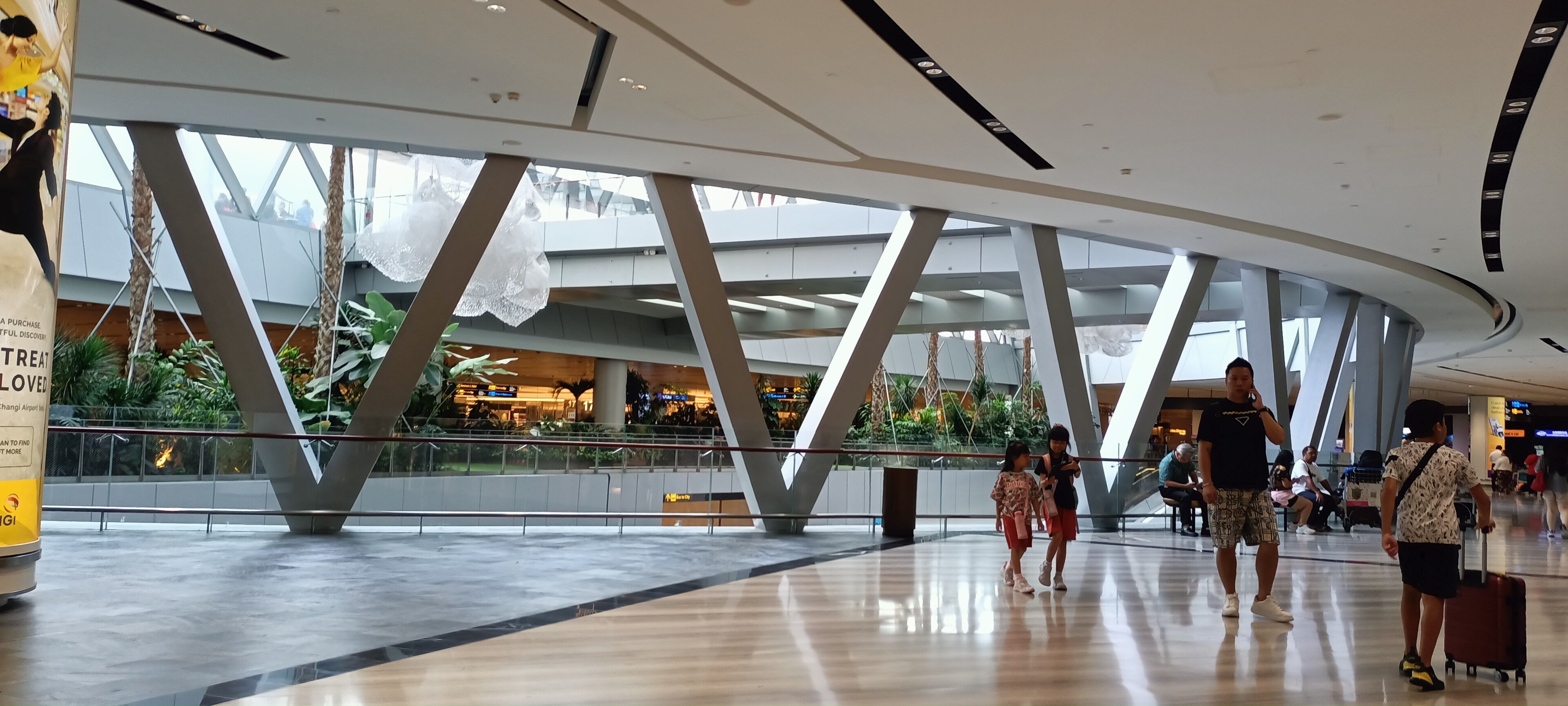
Photo: Uzoma Ozurumba / Wikimedia Commons, CC BY-SA 4.0
The company tax rate is 17 percent, and it falls to 13.5 percent or lower for some activities, according to Bloomberg. About 4,200 multinational companies have their regional headquarters there. Singapore also makes owning a car very costly on purpose, to push people onto trains and buses and cut its fuel imports. Compare that with what South Africans pay at the pump.
Is Singapore a democracy or a dictatorship?
It is a democracy with real votes, run by one party that has never lost. Singapore has a parliament modelled on Britain's, and citizens vote about every five years. The People's Action Party, or PAP, has won every election since 1959.
The most recent was in May 2025. The PAP won 65.57% of the vote and 87 of 97 seats. The opposition Workers' Party kept its 10 seats. Power has also changed hands peacefully three times. Lee Kuan Yew handed over to Goh Chok Tong in 1990, Goh handed over to Lee's son Lee Hsien Loong in 2004, and Lawrence Wong took over in May 2024.
Voters elect teams of MPs in group seats, called GRCs, where every team must include a member of a minority race. Critics such as press freedom groups point to limits on protest and the media, and the government says the stability is what pays for the housing, the schools and the jobs.
How did Singapore get rid of corruption?
It made getting caught certain, and made the punishment apply to the powerful first. Singapore's anti-corruption body, the CPIB, dates from 1952, but Lee gave it real teeth after 1965. Anyone caught taking a bribe went to jail, no matter how high they sat.
 Read nextShamonda virus just killed its first known human patient, in France
The best-known case came in 1986. Teh Cheang Wan, the minister for national development, was being investigated over about S$1 million allegedly taken from two property developers. He took his own life before he could be charged. Lee refused to protect him. Lee's reasoning, as the story is told, was that one exception would open the door for everyone.
The rule still holds. In October 2024 a High Court judge sentenced a former transport minister, S. Iswaran, to 12 months in jail for accepting gifts worth over S$300,000 and obstructing justice. The judge gave him nearly twice the jail time the prosecution asked for. News agencies called it the first case of its kind involving a political office holder in more than four decades.
South Africans know the other version of this story. We went through it in detail in where the ANC's corruption money went.
Why does Singapore pay its ministers millions?
So that a minister never needs a bribe, and so that good people leave private jobs to take the work. Lee doubled the pay of ministers and top civil servants in the early years. A cabinet minister's pay is tied to what the top earners in the private sector make.
An entry-level minister earns about S$1.1 million a year. The prime minister earns about S$2.2 million. Ministers took a 36 percent pay cut in 2012. In September 2026 an independent committee said the pay had fallen 40 percent behind its benchmark. The government proposed a rise of up to 9 percent from 15 October. Prime Minister Wong said he will donate his whole increase.
The pay is public, it moves with the economy, and the anti-corruption law sits right behind it. Singapore pays well and watches hard.
Why does almost everyone in Singapore own their home?
Because the government built the homes, sold them cheaply, and let people pay with their own savings. 91.2 percent of resident households in Singapore owned their home in 2025 (Singapore Department of Statistics). Roughly 3 in 4 people live in flats built by the Housing and Development Board, the HDB.
The scheme works like this. The government bought up most of the land after 1965. The HDB then built estate after estate and sold flats on 99-year leases at below market prices. In 1960 about 9 in every 100 people lived in public housing. By the late 1980s it was well over 80 in every 100.
The buyer pays from the Central Provident Fund, the CPF. Workers under 55 put in 20 percent of their wages, and their employer adds 17 percent, a total of 37 percent (2026 rates). That money can be used for the deposit and the home loan payments on an HDB flat, and also builds up for retirement and medical bills. The grants for low-income first-time buyers help on top.
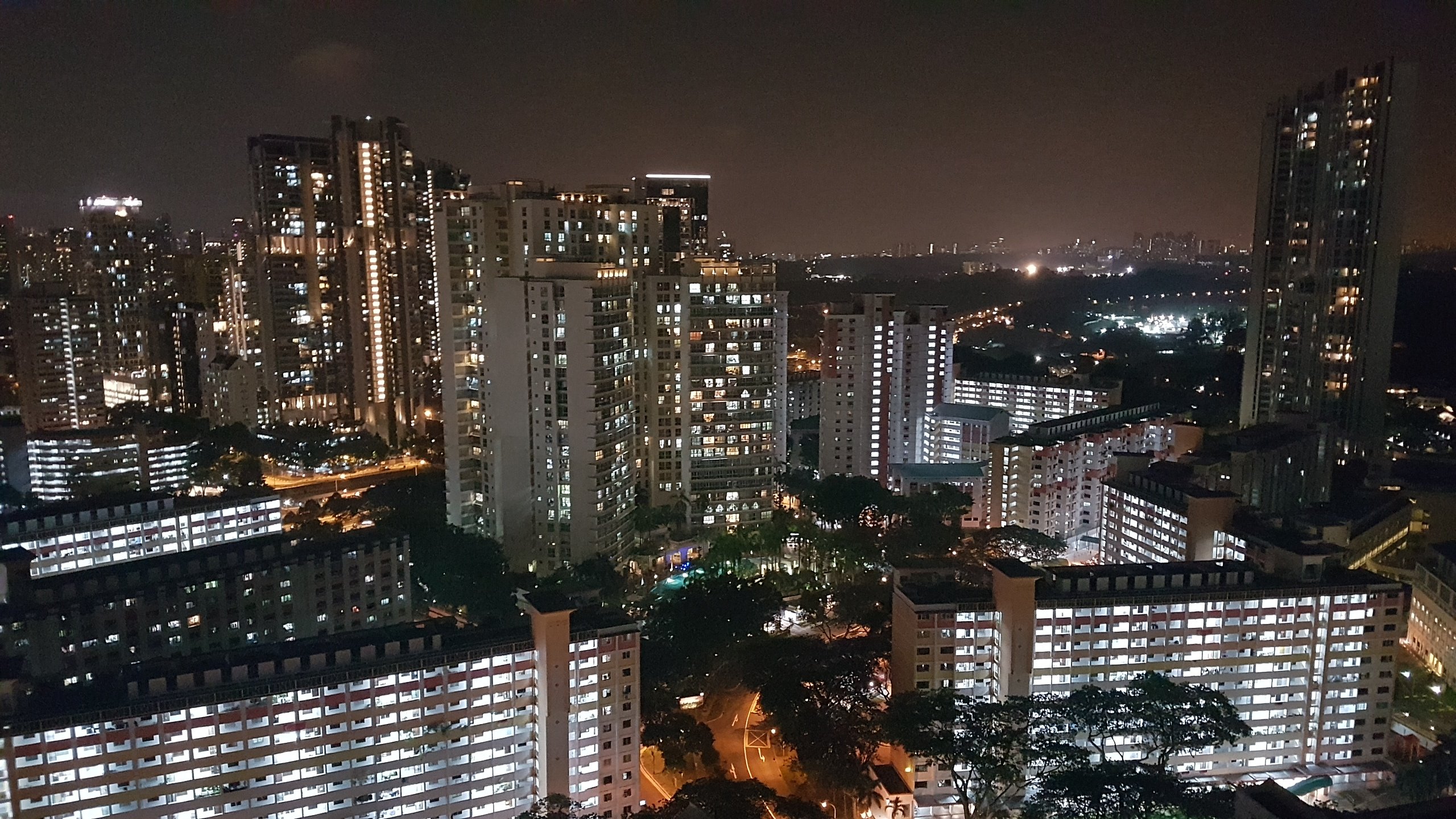
Photo: Orderinchaos / Wikimedia Commons, CC BY-SA 4.0
Lee argued that home ownership gave everyone a real stake in the country. A person with a flat to pay off, and to pass on, has something to lose. That makes people more careful with their block, their lift and their neighbours. The HDB also sets ethnic quotas for every block, so Chinese, Malay and Indian families live side by side.
What happens in South Africa when the house is free?
Many RDP houses are given away, and some do not stay with the family they were built for. The Reconstruction and Development Programme houses are paid for by the state. The housing minister said in 2015 that almost 3 million had been built since 1994, and that 3,411 had been sold by owners to private buyers. The rules do not allow a sale before the owner has lived there for eight years.
Reports of sales and renting keep coming. In August 2025 the KwaZulu-Natal housing MEC spoke of a groundswell of complaints about illegal RDP sales. In April 2026 Gauteng's department repeated that selling or renting an RDP house is illegal after a viral video. The Justice department said that video's claims were unlikely to be true.
Damage during protests is also on record. In October 2019 protesters in Noordhoek, near Velddrif in the Western Cape, set 53 newly built houses on fire. The province put the damage at R3.88 million. Officials said it delayed the families waiting to move in. In 2020 the Eastern Cape said it would rebuild the foundations of 100 vandalised RDP houses in Despatch.
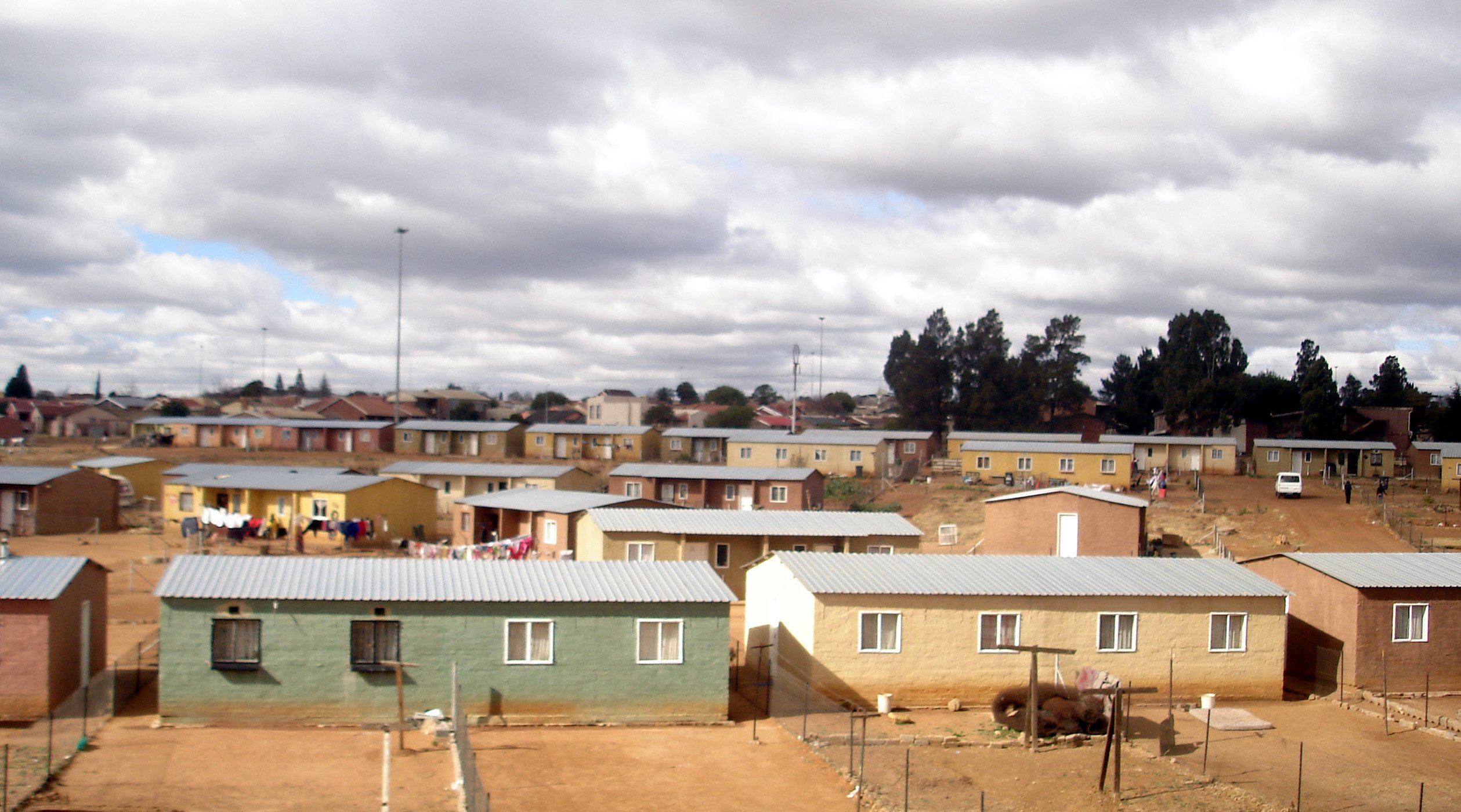
Photo: ign11 / Wikimedia Commons, CC BY 2.0
A free house and a house you pay off over 20 years change how people treat the place. The people who pay for the free house are other South Africans.
How many South Africans pay the bills for everyone else?
Far fewer than the number who get help. SARS assessed 7.7 million people for income tax in the 2024 tax year (SARS Tax Statistics 2025). The 1.5 million who earned over R500,000 paid 77 percent of all income tax. Treasury expects about 8.3 million people to owe income tax in 2026/27, and about 26.5 million people to receive grants. For every person who pays income tax, there are about 3 grant payments, though many are child grants and one person can get more than one.
We took these numbers apart in our story on how few South Africans carry the tax load. The R370 grant is also thin, as we showed in the story on the grant extended to 2027.
Singapore built the other way around. It did not run a welfare state for everyone. Help is tied to work and saving, and the CPF turns a worker's own wages into a house, a pension and a hospital bill. In Singapore more people have something to lose. In South Africa more people depend on those who do.
Why are Singapore's schools the best in the world?
Because the whole system is built to find talent early, train it well and feed it into jobs. In the OECD's PISA tests of 15-year-olds in 2022, Singapore scored 575 in maths, 543 in reading and 561 in science. It beat every other country in all three. In maths, 41 in every 100 Singapore students were top performers (OECD and Singapore's Ministry of Education).
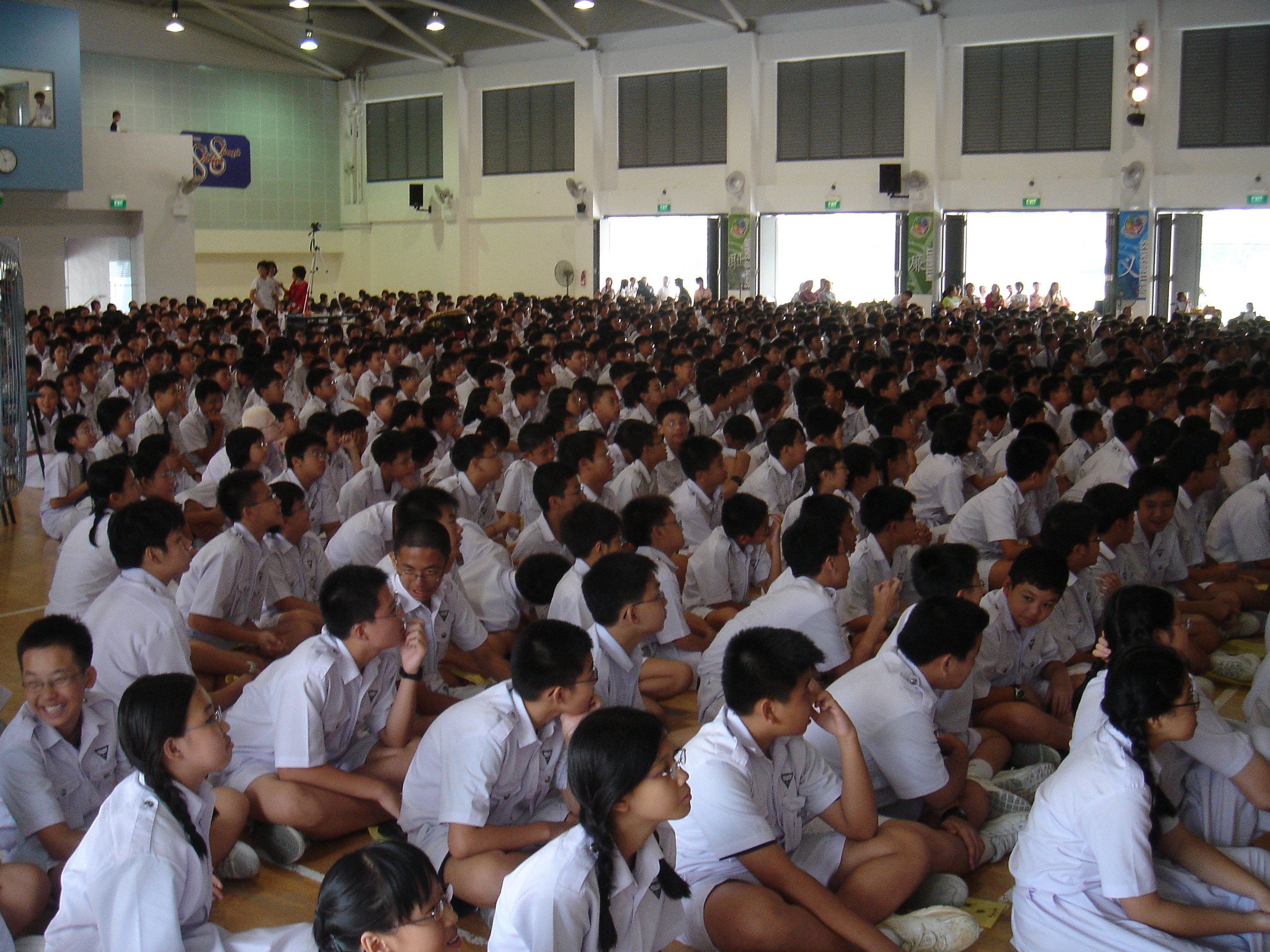
Photo: mailer_diablo. / Wikimedia Commons, CC BY-SA 3.0
The system has five parts.
- Children sit one big exam, the PSLE, at about age 12. It decides which secondary school path they start on.
- From the 2024 Secondary 1 intake, the old Express, Normal Academic and Normal Technical streams are being replaced with full subject-based banding. A student can take maths at a harder level and English at an easier one, and move up later. Mixed classes are the new norm.
- Maths is taught in three steps, from real objects to pictures to numbers, with a "bar model" that turns a word problem into a drawing.
- Teachers are picked from the top third of each graduating group and trained at the National Institute of Education, and they are paid while they train.
- Polytechnics and the Institute of Technical Education give a respected route to skilled work for those who do not go to university.
The system has a cost. Private tuition now costs families about S$1.8 billion a year (2023), because parents do not want their children left behind. The government has started to loosen the pressure with the streaming change.
 Trending nowPinetown dad fires back at gunmen at his gate, and what the law says
In South Africa, a 2021 international reading study found that 81 in every 100 Grade 4 learners could not read for meaning in any language. Singapore decided in 1965 that people were its only resource. It trained them for the jobs the factories were bringing.
How does a country with no water survive?
By treating its water supply as four taps. Singapore has long relied on Malaysia for water, under a 1962 agreement that runs out in 2061. It has spent decades making sure it never has to ask for a drop.
The four taps are rainwater caught in reservoirs, water bought from Malaysia, NEWater and desalinated seawater. NEWater is used sewage water cleaned until it is safe to drink. It can meet up to about 40 percent of demand, and desalination up to about 25 percent. Singapore also dammed its own bay at the Marina Barrage so the rain that falls on the city ends up as drinking water.
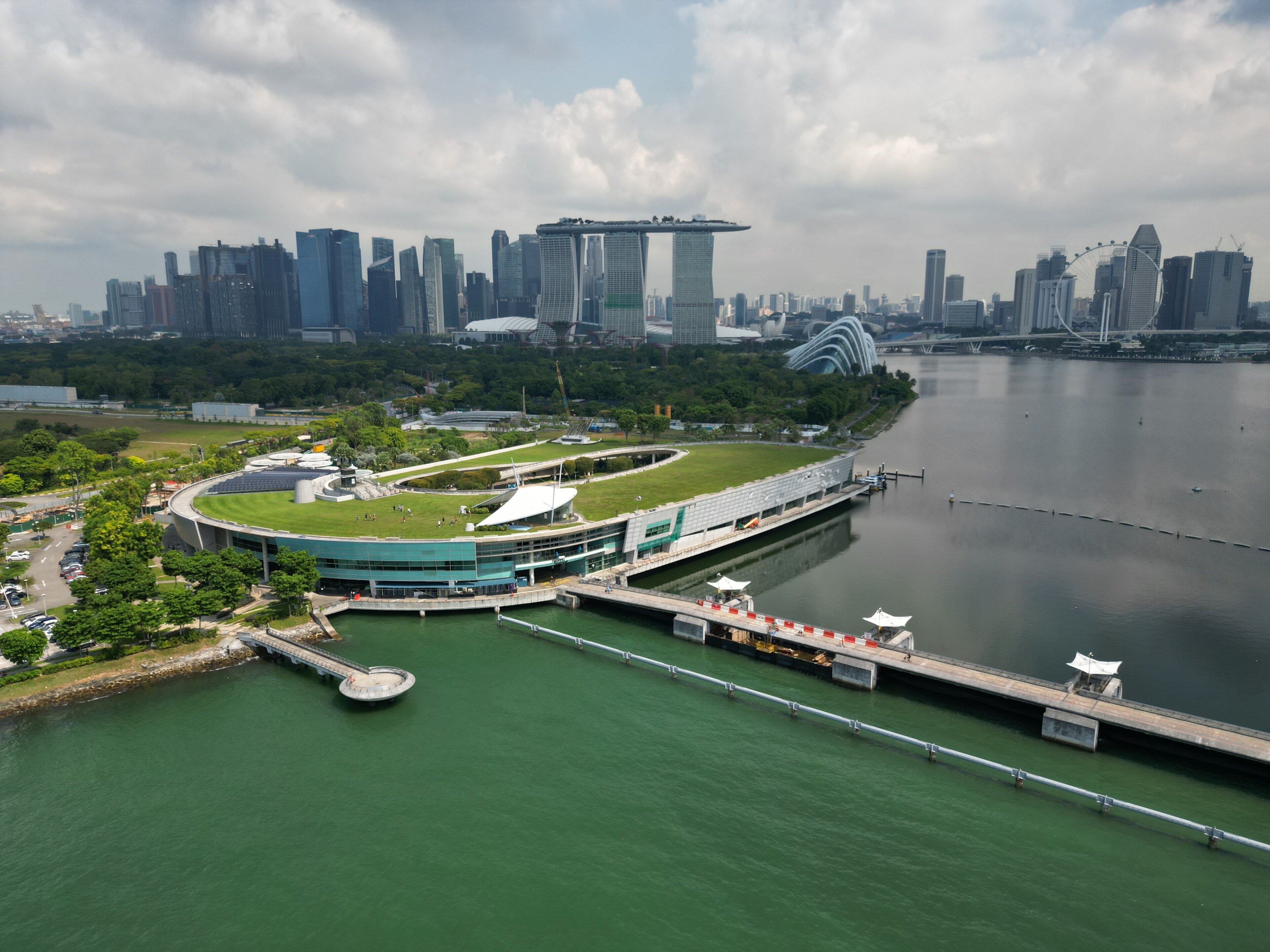
Photo: Bob Tan / Wikimedia Commons, CC BY-SA 4.0
The government aims to be fully self-sufficient in water by 2060.
Why are Singapore's laws so strict?
Because Lee believed crime and disorder scare away investors, and the law is the same for everyone. Chewing gum has been banned for sale since 1992. Littering, spitting and graffiti carry heavy fines, and vandalism can bring the cane. Drug trafficking carries the death penalty, and Singapore was among the top 10 countries for executions between 2022 and 2024.
The result is a place where business owners, parents and tourists feel safe. In 2025 the Singapore police recorded 7 murders in the whole country. South Africa recorded 26,232 in 2024, about 72 a day. The two numbers cover different years, but the gap is the same story told twice.
The law also protects contracts. A foreign company knows a Singapore court will treat it the same as a local one. That certainty is part of what the country sells to investors.
Why does every Singaporean man serve in the army?
Because the island has no room to retreat and no way to outnumber its neighbours. Malaysia and Indonesia both have far more people. Since 1967 every young man has served two years of full-time National Service, and then stays in the reserves. That gives a country of about 6 million people hundreds of thousands of trained men who can be called up in an emergency.
The service also mixes young men from every race and background in the same barracks at the same age.
Defence takes a big share of the budget. Singapore spends about 2.77 percent of its GDP on its military, more than Malaysia and Indonesia spend together, according to one 2025 analysis. The message to investors is plain. Their money is safe here, from inside and from outside.
How does a country with three races keep the peace?
By designing it in. Singapore is about three quarters Chinese, with Malay and Indian communities making up most of the rest. Race riots in 1964 and 1969 showed what happens otherwise. Lee's answer was a set of rules that look strict and work every day.
There are four official languages, Chinese, Malay, Tamil and English, and English is the common one. The HDB quotas mean no block can be all one race. Group seats in elections make sure minority candidates sit in parliament. Laws forbid preaching in a way that could stir up one religion against another. The state sets the boundaries, and inside them people get on with life.
Who pays when you get sick in Singapore?
You do, with help from your own savings and from insurance. Part of every worker's CPF goes into a Medisave account, which pays hospital bills. MediShield Life insurance covers big bills for every citizen. Patients still pay part of the cost, so that nobody treats care as free. The state also subsidises public hospital wards.
The idea fits the rest of the system. People pay in, and the rewards come back to them.
What does life in Singapore cost now that it is rich?
A lot, and the government says it is working on it. Housing resale prices have climbed since 2020, and the cost of living has risen. Singapore's birth rate has fallen to about 1 child per woman. Under Lawrence Wong, the government is building more flats, adding parental leave and child care support, and has already scrapped the old school streams.
Singapore still ranks as one of the richest countries on earth. Its median pay of around US$46,000 a year now beats the UK's, and by one 2025 estimate about 1 in 25 residents is a US-dollar millionaire. It has the third biggest financial centre in the world, behind New York and London.
Could South Africa copy it?
Not the island. The habits. Every big move Singapore made was a choice any country can make. Punish corruption the same for ministers and clerks. Teach children for the jobs that are coming. Let people buy and own the homes they live in. Keep the country safe and reliable for the people who want to build things.
South Africa has what Singapore never had. It has gold, platinum, farmland, a long coast and 63 million people. Singapore had a harbour and a plan.
We took the ten big moves and applied them one by one to the Cape, with real numbers, in what Singapore's planners would do if they ran the Western Cape.
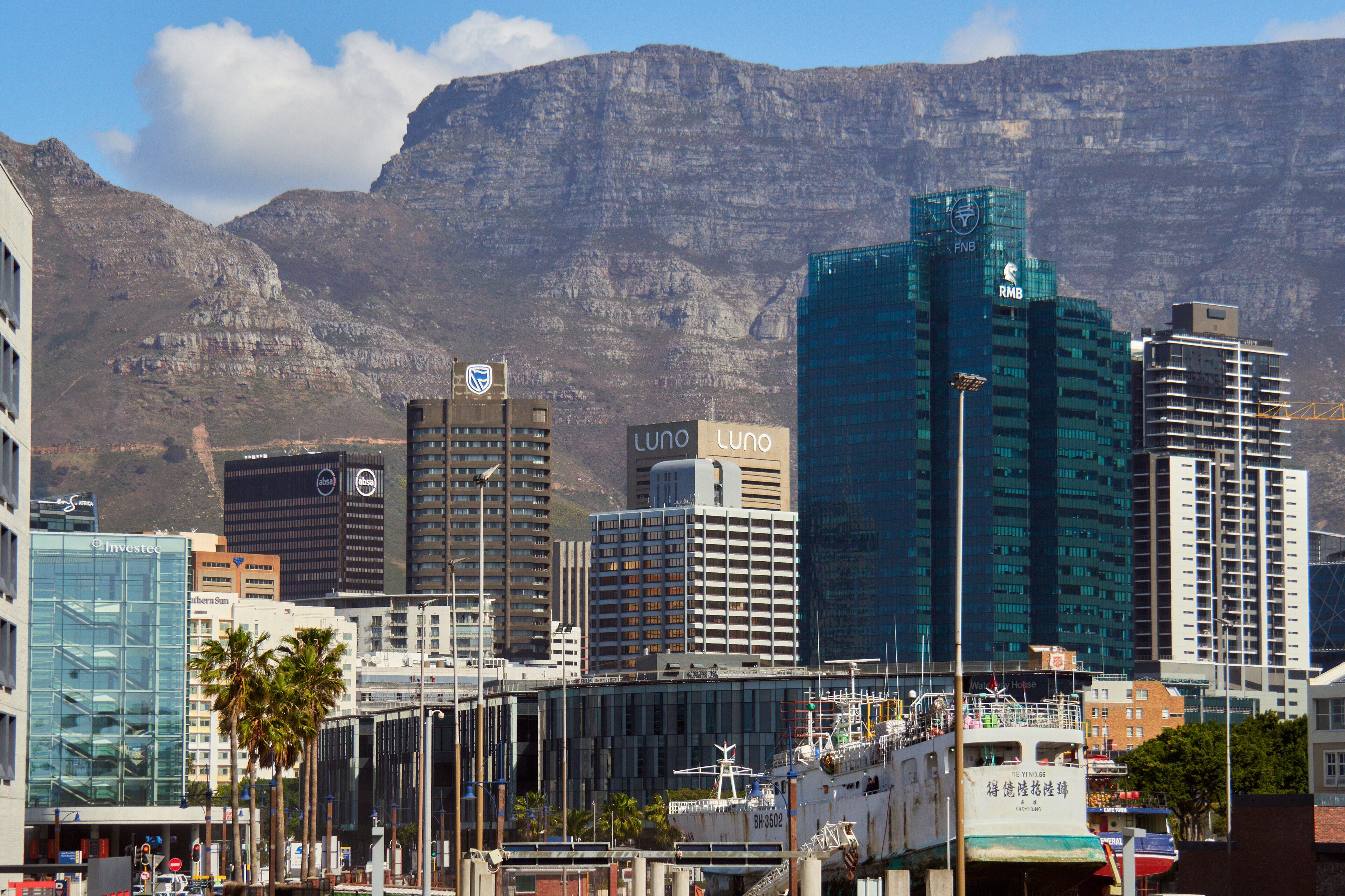
Photo: lumoplank / Wikimedia Commons, CC0
A South African who was 20 in 1965 is about 81 today. In that one lifetime, a poor island with no water went from US$517 a person to US$98,814, passing the United States on the way. Nobody gave it the money and nobody found a mine. A small group of people decided, every day for sixty years, that the country would work.
That is what Singapore proves. It was built inside a single lifetime, and some of the people who watched it happen are still alive to tell you what it felt like.
Get the stories that hit your pocket
Petrol, SARS, Eskom, grants and the news everyone is talking about. One short email every weekday at 6am.
Free. One email each weekday. Unsubscribe anytime.Sources18
- Documentary on how Singapore grew from poverty to wealth (18 Jan 2025)
- Video on Singapore's model, schools, housing and fertility (19 Sep 2026)
- Bloomberg explainer on how Singapore got so rich (10 May 2024)
- Video on how Lee Kuan Yew built Singapore (2 Oct 2025)
- World Bank, GDP per capita (current US$), Singapore and South Africa, 1965 to 2025
- Singapore central bank speech via the BIS, Economic history of Singapore 1965 to 2065 (7 Aug 2015)
- Singapore Department of Statistics, General Household Survey 2025 (home ownership 91.2%)
- CPIB, S. Iswaran sentenced to 12 months in prison (4 Oct 2024)
- OECD, PISA 2022 country note for Singapore
- Singapore Ministry of Education, PISA 2022 press release (5 Dec 2023)
- Singapore Police Force, annual crime brief for 2025 (7 murders)
- BusinessTech on SAPS 2024 murder figures (26,232)
- Malay Mail, Singapore ministerial pay review (8 Sep 2026)
- Mail & Guardian, government seeks to discipline those selling RDP houses (8 Jun 2015)
- Western Cape Government, Noordhoek house burning (Oct 2019)
- DispatchLIVE, foundations of 100 vandalised Eastern Cape RDP houses to be rebuilt (18 Mar 2020)
- Daily Maverick, PIRLS 2021, 81% of Grade 4s cannot read for meaning (16 May 2023)
- Parliamentary Monitoring Group, Human Settlements progress report
Keep reading
 ExplainedHow much of your "safe" index fund is really just 7 AI stocks
 ExplainedIs my tap water safe? Check your town's Blue Drop score
 ExplainedOnly three rich countries still charge an annual tax on what people own