Is 8 hours of sleep a myth? The sweet spot looks closer to 7
We grew up hearing eight hours. A giant study found the lowest risk somewhere else, and long sleep came with a twist nobody expects.

Photo: Brad Coy / Wikimedia Commons, CC BY 2.0
- The lowest risk sat at about 7 hours a night, not 8
- Sleeping 10 hours was linked to more risk than sleeping 5
- Scientists are still guessing why long sleep looks risky
Seven.
That is how many hours of sleep went with the lowest risk of death in one of the biggest sleep studies ever pooled. It was not eight.
The study joined up results on more than 3.5 million people in Asia, Europe, the US and Australia. Some were followed for 34 years. When the researchers drew sleep against risk, the line came out shaped like a U. The bottom of the U sat at about seven hours.
This week the old eight-hour rule took a beating online. One man wrote that he gave up on eight hours a decade ago and would sleep when he's dead. A reply calling eight hours a psyop, meaning a trick played on the public, passed 683,000 views in a day.
So is eight hours really a myth?
Is 8 hours of sleep a myth?
Partly. Eight hours was never a law of nature. It has an old history.
In 1817 the Welsh mill owner Robert Owen pushed a slogan for workers. It asked for eight hours of work, eight hours of rest and eight hours to do as you please. It split the day into three neat parts. It was about fair working hours, not a sleep lab.
Today, health groups give a range. The US National Sleep Foundation says adults need 7 to 9 hours a night, and 7 to 8 hours after 65. US sleep doctors, quoted by the CDC, set the floor at seven.
So eight sits inside the healthy range. It just isn't the magic number many of us grew up with.
Is 7 hours of sleep enough?
For most adults, seven was the sweet spot in the big study. The paper was led by Jiawei Yin and colleagues at Huazhong University of Science and Technology in Wuhan, China. It came out in the Journal of the American Heart Association in 2017.
The team gathered 67 earlier studies and pooled them into one. Between them they counted 241,107 deaths, plus tens of thousands of heart attacks and strokes. Then they compared every sleep length with seven hours.
Here is how the risk of dying from any cause changed. Seven hours is the baseline.
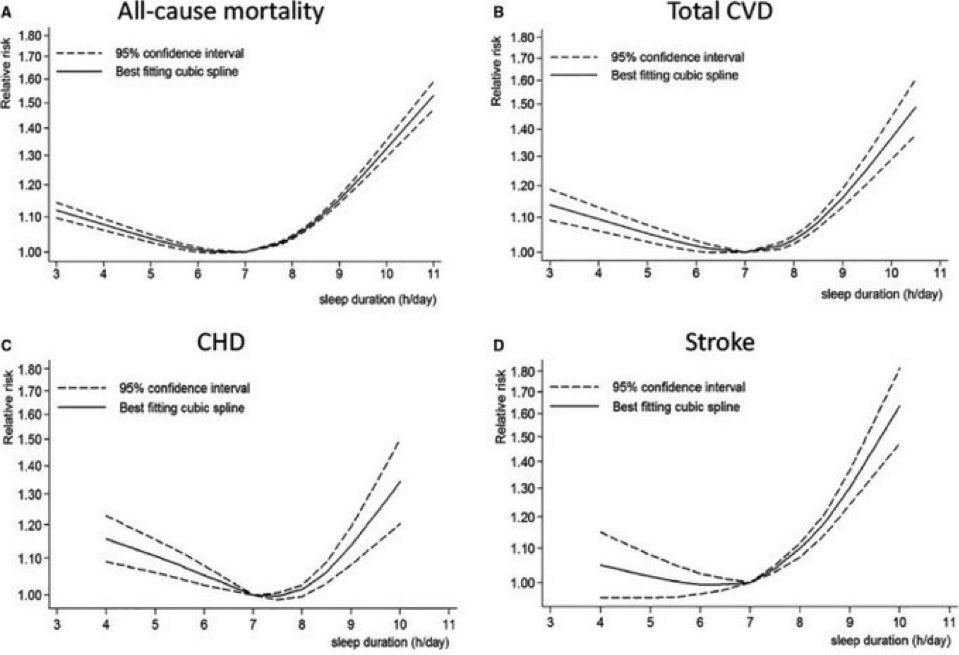
Photo: Yin et al., Journal of the American Heart Association
Look at the two sides. Short sleep pushes the risk up slowly. Long sleep pushes it up fast.
Photo: Joe Mabel / Wikimedia Commons, CC BY-SA 3.0
Can you sleep too much?
In the study, eight hours came with the same small bump in risk as five hours. Both sat about 4% above seven.
After that, the long side climbs. Nine hours came with 15% more risk. Ten hours came with 32% more. Eleven hours came with 53% more.
Each extra hour above seven added about 13% to the risk of death. Each hour below seven added about 6%.
The same shape showed up for heart disease and stroke. Stroke stood out most. People who slept ten hours had a 64% higher stroke risk than people who slept seven.
A second big review in the same journal in 2018 covered more than 3 million people. It found almost the same thing. Ten hours came with about 30% more risk of death, and eleven hours with about 47% more.
These studies show links, not proof of cause, and most people guessed their own sleep hours.
Why would more sleep be linked to higher risk?
Nobody knows for sure, and that is what makes it fun to think about. The Yin team said its ideas about long sleep are more of a guess than its ideas about short sleep. Here are the main ones.
Long sleep may be a sign, not a cause. People with a hidden illness often feel worn out and sleep more. The illness could be pushing up both the sleep and the risk.
Sleep apnoea is a big suspect. It is a condition where breathing stops and starts through the night. It can leave people tired all day, so they may stay in bed longer.
Too long in bed can also mean broken sleep. The authors point to studies that link choppy, broken sleep with damage to small blood vessels.
Daily life plays a part too. Long sleep has been linked with depression, lower income and less schooling. Each of those carries its own health risks.
So the extra hours might not harm the body at all. They might be a warning light on the dashboard.
Photo: Jonathan Soren Davidson for Disabled And Here / Wikimedia Commons, CC BY 4.0
What happens to your body when you don't get enough sleep?
The short side has clearer answers. The authors say cutting sleep upsets the hormones that run your body. Melatonin, the hormone that tells you it is night, gets out of step. Testosterone gets thrown off too.
Hunger hormones shift as well. Short sleep is linked to less leptin, the hormone that tells you that you are full. It is also linked to more ghrelin, the one that makes you hungry.
Shift workers may have it worst, the authors say, because their body clocks keep getting thrown off.
It is a big deal because short sleep is common. The CDC found that about one in three American adults sleep less than seven hours a night.
That is also why a Japanese man's claim got so much attention. He says he trained himself to sleep only 30 minutes a night for years, and he went live for a week to prove it. On the chart above, he would be far off the left edge.
How much sleep do I actually need?
The science points to a range, with seven near the safest spot. The National Sleep Foundation says six hours, or even ten, may suit some people. If you are far outside 7 to 9 hours night after night, it is worth a chat with a doctor.
People chasing a longer life already treat sleep as a tool, like food and exercise. The daily rules of a Harvard scientist trying to slow aging follow the same idea: Small habits, repeated for years.
Photo: Michael Nutt from New York, US / Wikimedia Commons, CC BY-SA 2.0
So should you stop chasing 8 hours?
Stop counting to eight like it is a test. Aim for about seven good hours and see how you feel.
Go to bed at the same time. Wake up at the same time. If seven leaves you sharp, you have found your number. If you need eight, you are still well inside the healthy range.
And to everyone who plans to sleep when they're dead, the biggest study on the question has a friendly reply. In the data, the people with the lowest risk of dying early were the ones who slept about seven hours. Sleep a little now, and you may get more years awake later.
Sources5
- The original post on X (8 Oct 2026)
- Yin et al., Relationship of Sleep Duration With All-Cause Mortality and Cardiovascular Events, Journal of the American Heart Association (2017)
- Kwok et al., Self-Reported Sleep Duration and Quality and Cardiovascular Disease and Mortality, Journal of the American Heart Association (2018)
- National Sleep Foundation's sleep time duration recommendations (2015)
- CDC, 1 in 3 adults don't get enough sleep (2016)
The week's biggest stories, every Monday
One email. The stories everyone will be talking about, before they do.
Free. One email a week. Unsubscribe anytime.Keep reading
 ExplainedWhy Shoprite wins while Woolies and TFG bleed
 ExplainedDoes the BBC pay white staff less? Its own numbers, band by band
 ExplainedEvery 2027 medical aid increase, in one table