The bank says you approved it. You never got the pin. Then it offers you a quarter back
A Harrismith woman lost nearly R60,000 and was offered about R16,000. She is not alone, and the letters that come with these offers have something in common.
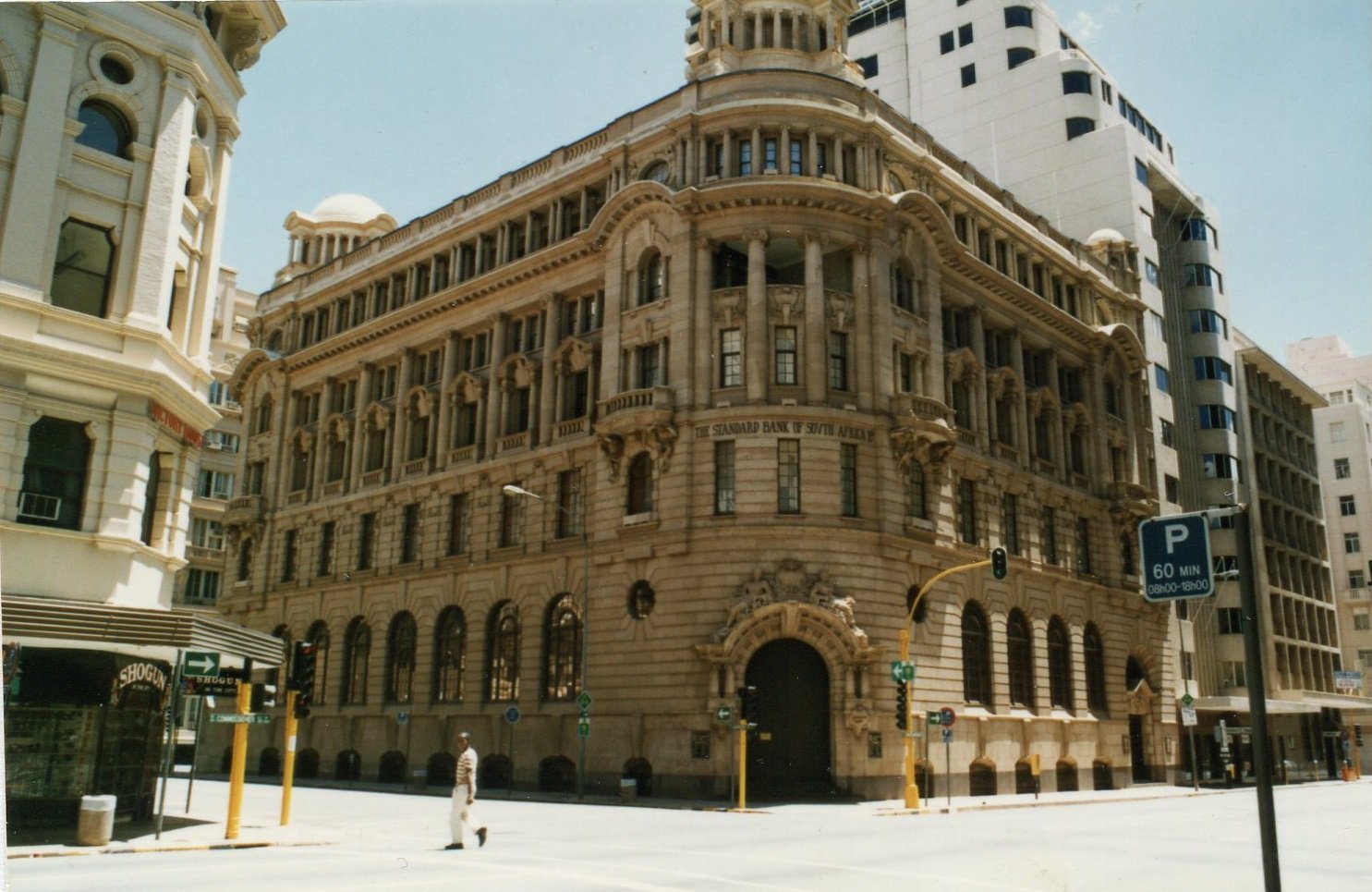
Photo: Johannesburg Heritage Foundation / Wikimedia Commons, CC BY-SA 3.0
- She lost nearly R60,000 and was offered about R16,000
- The bank says a pin proves she approved it
- The ombud sided with banks in 85% of fraud cases in 2025, IOL reports
R60,000 gone. R16,000 offered back.
That is the sum Anastasia Radebe from Harrismith was left with, according to IOL. She says the money left her Standard Bank account in January. She says no one-time pin (OTP) ever reached her phone. The bank told her the payments were approved with OTPs tied to her profile. She turned down the offer.
Her story was one of the first. In May, an IOL headline said fraud claims at the bank were nearing R60 million as more clients came forward from South Africa and Eswatini. We could not find a body total behind that headline, so treat it as the paper's own framing. The cases below are named in IOL's reports.
The pattern is the same each time. Money goes. The bank says an OTP proves the client approved it. Then comes a "goodwill" offer.
What is a "goodwill" offer, and why do clients say it feels like a trap?
Standard Bank's spokesperson, Ross Linstrom, told IOL that each case is assessed on its own merits. He said that even when no fault is found on the bank's side, it "may still consider discretionary goodwill assistance". The bank says this is not an admission of liability.
Clients hear something else. They say the offer is treated as final, and some say it arrives with a deadline. Typical offers run from 25% to 50% of the money lost, IOL reports.
Here is how the reported cases line up.
| Reported loss | Offer | Share offered | What the client did |
|---|---|---|---|
| R60,000 (Radebe) | About R16,000 | About 27% | Refused |
| R45,000 (MacDougall) | 25% payout, about R11,250 | 25% | Accepted, says he felt he had no option |
| R20,000 (Mphulo) | R4,600 | 23% | Reported as offered |
| R5,800 (Mphuti) | R1,600 | About 28% | Reported as offered |
| R340,000+ (Katts) | 50% | 50% | Offer came with a deadline and an NDA, she closed her account after 38 years |
Sources: IOL and Cape Argus reports, April to May 2026. Shares worked out by us from the reported amounts.
Take the first row. Radebe lost R60,000 and was offered about R16,000. That leaves about R44,000 she would carry herself.
Does an OTP really prove that you approved the payment?
That is the whole fight. The bank says that where OTPs, PINs or login details are recorded as used, a payment is normally treated as authorised. It says it does not store customer passwords or OTPs, and that these can be stolen through phishing, smishing or vishing.
Clients say a record of a pin being sent is not a record of who typed it in.
Olivia Horlacher says her elderly grandparents had an R5,000 transaction limit. She says more than R36,000 left their account within minutes. The bank says they received and accepted several OTPs. She calls that false.
Chartered accountant Altaaf Kader disputed a card payment of about R65,000 that was made in Dubai. He says he had passport proof that he was not there. In his case the bank said its records showed an OTP was generated and sent to his device. When he later said his phone had been compromised, the bank said that did not change the outcome.
Karel du Plessis, who commented to IOL, says independent forensic tests of a client's phone are rarely done. His view is that the conclusion is almost always that the customer compromised their own account.

Photo: Océanos y dados / Wikimedia Commons, CC0
What happens when you take it to the banking ombud?
Standard Bank tells unhappy clients to go to the ombud, the National Financial Ombud Scheme (NFO). It is a free, independent body that settles disputes between banks and customers.
The numbers are hard to read. IOL reports that in 2025, 85% of banking fraud complaints were settled in the banks' favour. Customers claimed over R271 million. About R30.7 million came back.
That is about 11 cents back for every rand claimed, by our sums.
In one case the ombud found no grounds to blame the bank. The Segers family lost R435,350 in three payments in August 2025. The ruling mentioned a phone running "Android OS 36", which the family disputes. They have filed a request under the access-to-information law (PAIA) for the technical evidence.
The ombud itself says it is a dispute body, not a forensic lab. It decides on a balance of probabilities. That means it asks what is more likely, not what can be proved beyond doubt.
What did the bank say about the silence clause?
IOL reviewed settlement letters and says they carry near-identical confidentiality terms. One tells a client they may not share any detail without the bank's consent. The bank may demand the money back if they do.
Standard Bank says such clauses are standard, protect privacy, and do not stop clients from going to police, regulators or the ombud. It also says goodwill payments are not publicly disclosed.
The ombud has been blunt. It said no agreement may contain terms that are against the law. A clause that stops you helping the police "would be unlawful".
Richard Hart told IOL his mother was offered R5,000 with an NDA. He asked why anyone would sign away the right to help police.
Standard Bank also confirmed a security incident on 23 March 2026 involving client information. It says there is no evidence linking it to the fraud cases. It said it laid criminal charges against a former employee but gave no detail. It also says it does not offer insurance for individual client fraud losses.

Photo: Dan Brown from London, UK / Wikimedia Commons, CC BY 2.0
What should you do in the first hour after money leaves your account?
Nobody can promise you a refund. These steps protect your case.
- Call the bank's fraud line and ask them to block the cards and your digital profile. Note the time and the name of the person you spoke to.
- Ask for a reference number for the dispute.
- Change your banking password and your email password. Do it from a device you trust.
- Call your mobile network. Ask if your SIM was swapped or a number was ported. Ask for the date.
- Open a police case and keep the case number.
- Write a timeline with the exact times of each payment and what was on your phone.
- Screenshot your transaction history before anything changes.
- Ask the bank in writing for the OTP log. You want the number it was sent to, the time, and the device that approved the payment.
- Do not sign anything quickly. If a goodwill offer has a deadline, read every line first. Ask what you give up by accepting.
This is general information and not legal advice. If a lot of money is involved, a lawyer is worth a call before you sign.
How do you go to the Banking Ombud?
Start with the bank. Ask for its final written answer to your complaint. If you still disagree, you can take the complaint to the NFO. It is free for consumers, and its website is nfosa.co.za.
Send it everything from the checklist above. Include the OTP log and any PAIA request. The ombud's own words suggest what matters most. It decides on what is more likely, so a clear timeline and proof you were somewhere else can count.
If you are reading about banks and money leaving accounts, our earlier stories on FNB customers going into the minus and the R200 "item paid" fee show how often people get stuck fighting their own bank. Our guide to why a bank account goes negative covers the basics.
Why do the letters all sound the same?
Ann Katts was a customer for 38 years. IOL reports she lost more than R340,000 from four accounts. She was offered half, with a deadline and an NDA. She closed her account.
Hart's mother was offered R5,000 and an NDA. Paul Horsfall, group CEO of Tennant Consolidated, was offered 50%, according to IOL. Different people, different losses, different stories.
The silence clause barely changed from letter to letter. Same wording for a pensioner and for a company boss. And the ombud has said that a clause like it, if it stops you talking to the police, would be unlawful.
Sources6
- IOL, More Standard Bank clients come forward as fraud claims near R60m in losses (6 May 2026)
- Cape Argus, Standard Bank clients challenge OTP claims after fraud losses (Apr to May 2026)
- IOL, Harrismith woman rejects R16,000 offer from Standard Bank after R60,000 fraud (10 Apr 2026)
- Cape Argus, Are OTP claims enough? Standard Bank defends its fraud investigation process (8 May 2026)
- IOL, Millions lost, silence demanded: Inside Standard Bank's fraud crisis (17 May 2026)
- National Financial Ombud Scheme South Africa
The week's biggest stories, every Monday
One email. The stories everyone will be talking about, before they do.
Free. One email a week. Unsubscribe anytime.Keep reading
 MoneyBanks are financing a flood of Chinese cars. Here is the risk
 ViralGTA 6 radio stations: All six, the DJs and the songs
 WorldPope Leo XIV on beauty, tech and why young people need to slow down